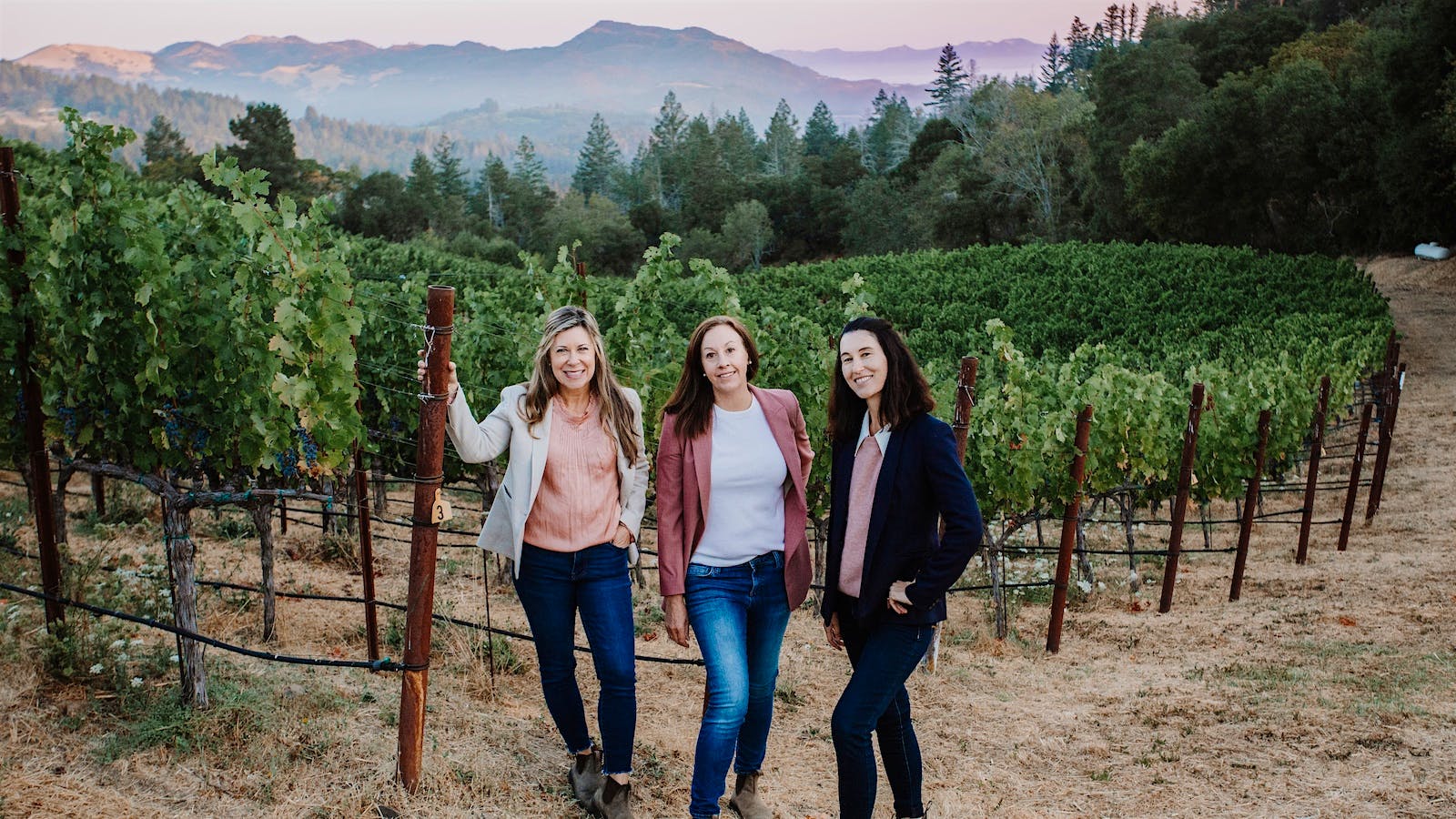


It’s a novel idea: a limited-production, single-vineyard Napa rosé made with the same attention to detail as a $300 bottle of Cabernet Sauvignon. That’s the challenge that three winemakers set for themselves in 2023.
Winemakers Molly Hill, Ashley Hepworth and Sally Johnson Blum have been friends for years and have decades of experience between them. When Hill suggested the idea, Hepworth and Blum were quickly on board.
They've come to call their project the House of MAS, taken from their first initials, and it's nothing if not ambitious. Their first release, Abloom Single Vineyard Napa Valley Rosé 2024 (89 points, $150), shows impressive potential. It’s a lovely, sleek and supple blush, with a gorgeous texture and floral aromas of strawberry, blood orange and savory spice flavors that linger on a dry yet lush finish.
All three women have strong winemaking résumés. Blum made wine at Pride Mountain for 15 years and St. Francis for eight before becoming a consultant. Her clients include Tamber Bey and The Walls along with her own label, Stereograph. She oversees the day-to-day winemaking for Abloom in the cellar at Tamber Bey.
Hill was the longtime winemaker at Sequoia Grove and has her own brand, GRO. She runs the business side of the partnership.
Hepworth spent 15 years as winemaker at Joseph Phelps, and is now a consultant for Phifer Pavitt, Hensel West and others. She too has her own label, A.Aitch, and handles sales and marketing for Abloom.

Meet the Women Behind Abloom, Napa's New $150 Rosé
I recently met with the trio on the patio of Harvest Inn in St. Helena. “This has never been done before in Napa Valley,” Hill said of the scope of their aspirations.
“We wanted to craft a Bandol-style rosé, aiming for a luxury model," added Hepworth. "We wanted to be the Château d’Esclans Garrus of Napa Valley.”
France’s Bandol appellation, as well as the broader Provence region, are celebrated for their dry rosés. I review rosés in California, Oregon and Washington. and there are many beautiful blush wines, both dry and slightly sweet in style.
Pinot Noir is the most prominently used grape, but Rhône varieties like Syrah and Mourvèdre are popular, and there’s still the occasional Zinfandel pink. (Just don’t call it White Zin.)
What Makes Abloom Different from Other Rosés?
“It took us about a year to find the vineyard that we wanted to work with,” Blum said. “So we spent that first year planning, brainstorming, applying for all our permits and licenses and getting the label design right.”
The trio eventually found their ideal fruit source at 1,400 feet on Mt. Veeder: a parcel of old Alban clones of Grenache in Paras Vineyard. The vines were planted in 1991 and 1994 and manage to produce a skinny 2 tons per acre.
“It took us a while to find something that was worthy,” Hill said.
“We think that wine is all about place,” said Blum. “We wanted to make a wine that really explores and dives down deep into a single place.”
Most rosés in California are made via the saignée method (French for “bleed”), which draws juice off the fermenting must of a red wine to intensify what remains in the tank. The drawn-off byproduct then becomes rosé. The method is easy and inexpensive.
Benchmark rosé producers in Southern France follow the more demanding approach of direct press. Grapes are farmed and harvested specifically with rosé in mind, which requires the grapes to be picked earlier in order to preserve acidity and maintain lower alcohol levels. The grapes are then gently pressed, sometimes with whole cluster, and then briefly macerated on the skins to gain their salmon to garnet hues.
Abloom follows the latter method, as the partners believe rosé is anything but an afterthought. “Especially single-vineyard rosé. There's no room for error,” Hill said. “From the picking decision, to how long you let it sit on the skins, to how much you press it. All of those factors have to be spot on.”
Such a detailed approach to winemaking comes at a cost. The rosé sells for $150, making it among the most expensive in California. “We're paying Cabernet prices for the grapes. Our custom crush is done at the highest level. It is as expensive to produce as Oakville Cabernet,” Blum said.
There are only 100 cases of the debut 2024, with most sold direct-to-consumer. While many think rosé’s prime consumers are women, Hill said, not so. “We really wanted to target a wide audience, and we're really pleased that most of our customers are men.”
One thing that does not seem to be a challenge for the partners is working together. These are three winemakers who’ve made names for themselves and produced impressive wines that made our Top 100, yet they keep their egos in check.
The three laughed when I asked them how they managed that. “We are all very good communicators and we all are very good friends,” Blum explained. “We really do make all of the decisions together. We probably work harder than we might if we were doing it alone. We don’t want to let down the other partners.”
Read all of our Winery Intels, follow senior editor Tim Fish on Instagram at @timfish_wine, and never miss an update with Wine Spectator's free email newsletters.