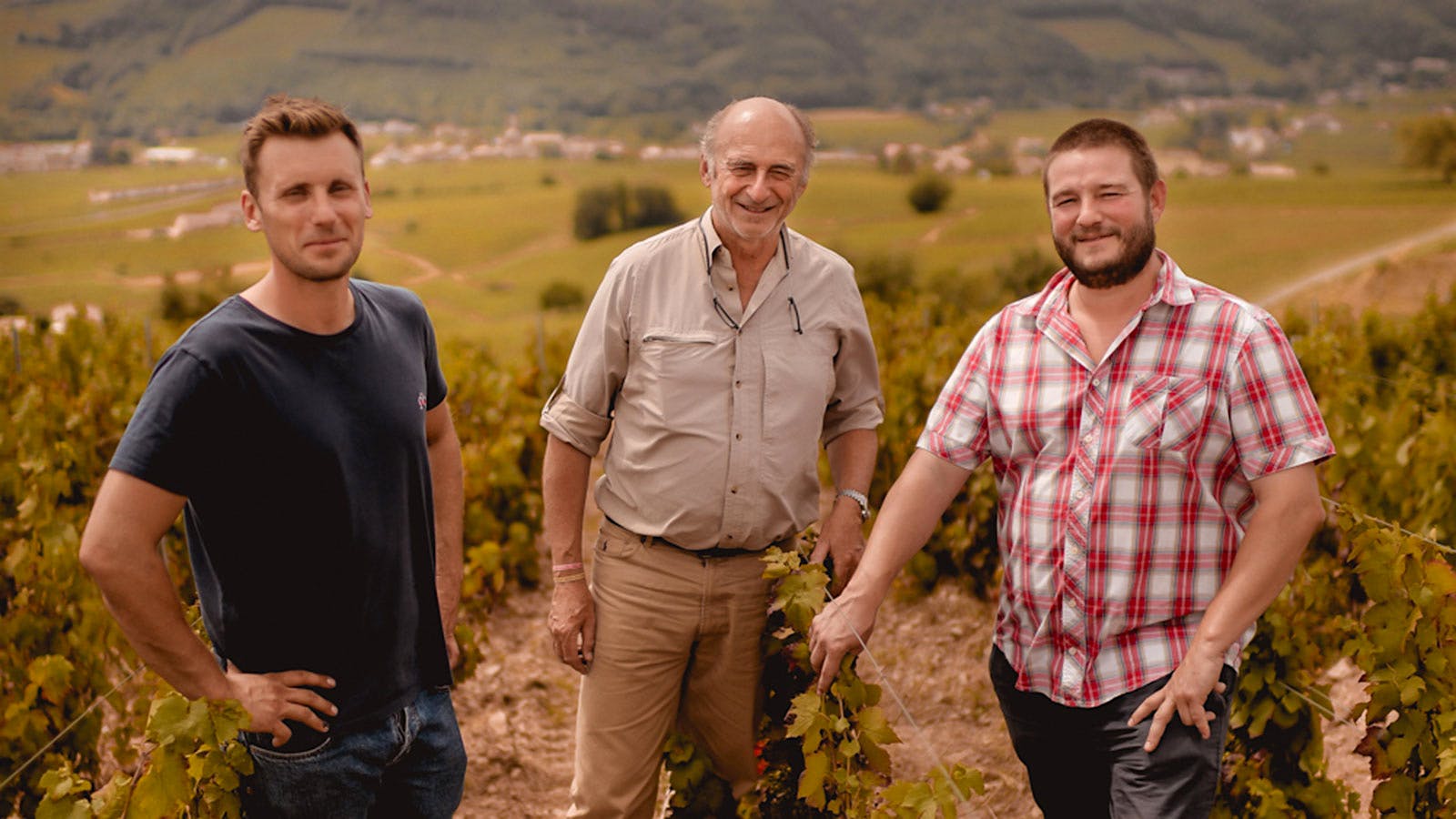


Philippe Pascal didn't want to spend his retirement simply drinking great Burgundy–he wanted to make it. After decades as an executive at luxury giant LVMH, working as CEO at Moët Hennessy Group (the wine and spirits part of LVMH), then heading its watches division and serving as adviser to LVMH CEO Bernard Arnault, Pascal purchased Cellier aux Moines, a run-down ancient monastery with vineyards, in 2004. Eight years later, he left corporate life behind to focus on it full-time.
The property's location in Givry, a less-celebrated appellation in Burgundy's Côte Chalonnaise region, smelled like an opportunity to Pascal. "The terroir was on a par with its neighbors, it was just not as well known."
He has the same hunch about Juliénas, one of the ten designated crus in Beaujolais—and one of the more underrated. Two years ago, he and Aux Moines winemaker Guillaume Marko acquired Mont Bessay, a neglected estate of vineyards perched atop a hill with stunning views.
"I'm convinced of Juliénas' potential—it is the most northern and most 'Burgundian' of the Beaujolais crus–essentially an extension of south Burgundy," said Pascal. From the panoramic view on Mont Bessay's hilltop, one can see the vineyards of Burgundy's Mâconnais region.
Pascal believes his success out of the gate at Mont Bessay (the inaugural 2021 cuvées, Juliénas En Bessay and Moulin-à-Vent Le Vieux Bourg, received 91 and 90 points from Wine Spectator, respectively) is the result of his learning curve at Cellier aux Moines. He labored for more than a decade to turn that dilapidated estate around, becoming the first winery in Givry to convert to organic and then biodynamic viticulture, and constructing a new, fully gravity-fed winery.
In 2015 he hired Marko, whose resume includes stints at Burgundy's Arnoux-Lachaux and Domaine de la Romanée Conti. The winemaker introduced whole cluster fermentation and a single-plot winemaking approach.
"Guillaume and I were having so much fun working together so we wanted to start a new project, where Guillaume could be an investor," explained Pascal. "The challenge was to find a place where we could afford great terroir, and Burgundy was out of the question. So we turned to the northern part of Beaujolais with the best terroir."

They are not the first Burgundy producers to invest to the south in Beaujolais. In recent decades, Bouchard Père & Fils' owners purchased Château de Poncié, Louis Jadot took over Château des Jacques and Louis Latour acquired Vins Henry Fessy. The opportunity to acquire affordable land close to home is compelling. Outside investment has helped turn Beaujolais into a hotbed of innovation—and wine quality has soared. (So have prices, but they remain well below Burgundy).
But Pascal and Marko are pioneers in their cru. "Juliénas is more under-the-radar compared to Morgon or Moulin-à-Vent," said Pascal. "It is what you would call a sleeping beauty." The duo was lured both by Mont Bessay's terroir—a south-facing, high-elevation site with an ideal mosaic of soils—and also by the chance to invigorate another undervalued region.
"So many young people are changing the game in Beaujolais," he said. "There is more organic viticulture than in Burgundy, with vignerons really responding to climate change. In the 19th century Juliénas [wines] were trading for as much as top Burgundy, but the whole region changed after World War II and with the popularity of inexpensive Beaujolais Nouveau."
Applying the same philosophy as at Celliers aux Moines, Marko and Pascal have converted the abandoned vineyards to organic farming and have embarked on an ambitious and time-consuming replanting program for the neglected Gamay vines. They will begin with a plot-by-plot winemaking approach to understand the diversity of terroir across their 17 acres of vineyards. "It took me 15 years to really understand the terroir of Givry, it was a steep learning curve," said Pascal. "But this will be faster. I'm a bit older and Guillaume is a bit more experienced."
Their first vintage, 2021, was a challenging one—damaging spring frosts, then a wet, rainy summer—and yields were very small. "We had no cellar so we made the wine in a small garage," Pascal said. They didn't want to bring the grapes to their Givry facility, despite its proximity, as they feel strongly that the wine should be made where it's from. A new cellar on the top of Mont Bessay has now been completed.
Fans of Celliers aux Moines will find a similar vein of purity and elegance in Mont Bessay's cuvées, a result of Marko's Burgundian approach: Meticulous sorting, the inclusion of stems, gentle extraction for silky tannins, no new oak. What sets the wines apart from many of the finest cru Beaujolais is longer barrel aging—close to two years. "We believe this gives us softer tannins and helps the structure of the wine as well. Maybe we lose a bit of fruit but we gain longevity and structure by longer barrel aging."
As for the label, which features a rabbit in boxing gloves, that's also inspired by the terroir. "Every time we walked the property, we saw hares standing on their hind legs kicking each other–this is what they do in mating season." In spite of the disruption of reclaiming the hillside vineyards, trellising and replanting, the hares remain, said Pascal. "They are still here, watching and checking on us."
Stay on top of important wine stories with Wine Spectator's free Breaking News Alerts.