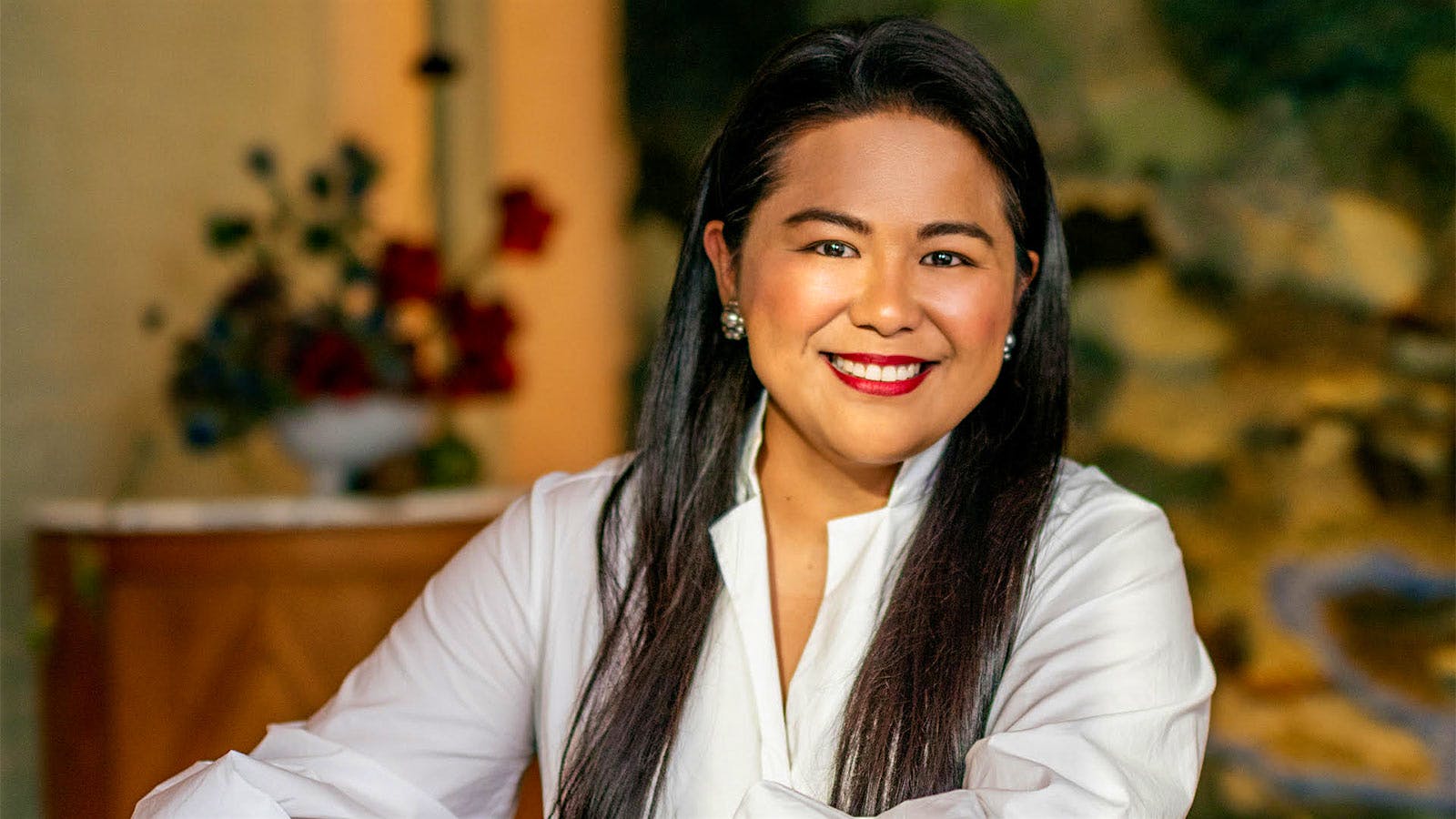


So much has changed since Wine Spectator last caught up with Master Sommelier June Rodil. Since moving down, in 2019, from Austin to Houston—widely considered to be one of the most exciting places for dining in the United States—Rodil has cemented herself as not only one of the country’s premier wine professionals, but a leading light in the restaurant industry at large.
With its dusty-pink dining room, Best of Award of Excellence winner March opened in 2021 in the heart of the trendy and vibrant Montrose neighborhood, serving as the flagship restaurant of Goodnight Hospitality. With March, Rodil and chef Felipe Riccio (also a partner in the business) hope to achieve what they see as fine dining’s full potential. That involves months of planning and research—and a serious embrace of change. The menu and central thesis of the restaurant change every few months to a new topic, always centered on Mediterranean culinary traditions. Past menus have included Greece and its role as the “cradle of Mediterranean culture,” the French and Italian fusion born in the seaside city of Genoa, and Països Catalans, focused on the heritage of Catalonia.
“We always joke that March is our love letter to the hospitality industry because it’s built on people who truly love dining,” says Rodil. “There are a lot of restaurants that are imbalanced; it’s either all about food or wine or service or design and atmosphere. We wanted a level playing field for those four tenets of restaurants.”

When the kitchen changes, the wine list follows suit, encouraging Rodil and her team to embrace new regions and styles and expand the restaurant’s repertoire with each theme. The restaurant is currently in its ninth “season,” dedicated to Venetian cuisine.
With Goodnight Hospitality, Rodil hopes to create restaurants that could serve any diner. Their spots are not just intensely researched tasting menu destinations like March, but also concepts like a wood-fired pizzeria. Take Award of Excellence winner Rosie Cannonball, which offers just as holistic an experience as March, even though it’s not a “fine-dining establishment.” With her approach to the wine list, Rodil hopes to prove that quality and approachability can coexist.
“You’re not going to get a wine from every country at Rosie Cannonball, because it’s a Eurocentric concept. It is a live-fire, European country food concept with a lot of French, Spanish and Italian influence,” says Rodil. (The group also operates Montrose Cheese & Wine, a wine shop and bar in its namesake neighborhood. Rodil still owns the restaurant June’s All-Day in Austin.)

“We love to have a diverse set of restaurants and outlets, because we love wines from all over the world and we want to represent them,” continues Rodil. “Sometimes a wine doesn’t work in certain concepts, but we can find a place for it. We want our guests to say, ‘I just feel like having a pizza tonight, but I know they’re taking care of their pizza the way they’d take care of their Domaine de la Romanée-Conti.’”
Late last summer, the group’s newest restaurant, the Marigold Club, made its debut. It’s a Technicolor dreamscape with a midcentury London flair. Think luxe goldenrod velvet banquettes, 1950s-style trompe l’oeil murals and a Steinway baby grand piano. Champagne is the core of the wine list. “The hook for Marigold Club is fancy, not formal,” says Rodil. “We spent the time, craft and money on it to create a space that just didn’t exist in Houston.”
Rodil sat down with Wine Spectator assistant editor Julia Larson to chat about what hooked her on restaurants, the regions she thinks wine lovers should pay more attention to and the one wine pairing that never gets old.
What was the restaurant that made you fall in love with restaurants?
I love that question. When I took my Certified Sommelier exam in San Francisco, I was a loner. When I decided to take the exam, I thought, “I’m not going to take it in Texas. I’m going somewhere I don’t go often.”
So I went to San Francisco. Whether or not I passed, I was going to spend a couple of days in Sonoma to visit some wineries. I went to the original Cyrus by myself and it was awesome. I saved my pennies. I ate at so many fine dining restaurants in the aughts—that decade was me figuring out how to dine by myself with a book. I would have a book and start talking to someone. One of the wine directors who used to work there, Jim Rollston, met me years later and said, “Oh yeah, I remember you! You always remember your weird tables for one.” People would ask if I was a Michelin inspector.
With our restaurants, it’s as if we’re inviting someone into our home. You don’t just sit them down, say “here’s the food,” and that’s it. You make sure your bathrooms are perfect. You sit down for a second—that’s why we have a lounge at March. You decompress, you disarm. Cyrus had that! There was this beautiful intuition Cyrus’ team had as my meal progressed—as they got to know me more, the tone subtly changed. That’s what happens in genuine conversation!
There’s a progression in service and hospitality, especially with a tasting menu. Cyrus was such an amazing experience because they were genuinely interested in me. I love that. Real conversations with people make food taste better. Felipe will always say that the food is circumstantial. It’s the same with wine: Things taste better if you’re setting up an environment that makes them taste better.
What sets Houston apart as a wine-drinking town?
Houston is an expansive city, and the people have such expansive palates! You can find something for everyone. Though similar to how it takes a full hour to get somewhere in the city, it does take a minute to find your community, especially if you have a very particular palate. Houston has all of the world combined. There’s a huge group of younger, newer sommeliers and wine professionals here, and we can all mingle with collectors and new enthusiasts. That’s pretty badass.
What is it like working with chef Felipe on menus?
He’s my favorite chef to collaborate with on menus—they’re done quickly. It’s hard to tell a chef that the wines need to shine as well. Felipe actually makes adjustments. Felipe will ask me to pull bottles—he’s also a Certified Sommelier. He took two years off to become a sommelier because he loves wine so much. We have a great rhythm when we do wine pairings.
For new seasons, we taste the pairings with the dishes multiple times. We don’t just taste the ingredients together. First, we taste the dishes, and then we adjust them. The second time, we have a whole plethora of wines that could potentially work based on what we tasted. We take notes of what works, then I take that bank of information and do another tasting. You’ve got to want it. It’s an investment in time, conversation, money, all of those things.
Of these different seasons at March, what has been your favorite to work with?
I loved the wines of Països Catalans. We tried to tell the story of how Spain and France come together. There’s such a continuity there that you don’t think of unless you start looking at the food and the culture.
When did you realize that you wanted to lean more into restaurant operations?
Pretty early on! Being an Asian immigrant, I learned that you have to find your worth, and that’s not just your self-worth. That’s still something that I’m working on—any day now, I’m going to understand my self-worth. For me, it was like I needed to be worthy of my job or my position so that I could continue the things that make me impassioned, which are wine and food.
I always had this idea that I needed to know everything to make sure I was as successful as possible. I grew up in such an unstable way—we were poor. I grew up in a little village outside of Manila. My grandpa was a fisherman. It’s such a wild world that I’m here now. I just really wanted to be stable, because with that feeling of foundation, you can do things that give you your spark. Eventually, creating foundations for others became my interest.
Have there been any ideas for your restaurants that haven’t worked?
I want a cheese cart; one with wine pairings on the same cart. But then I would have to teach people to be able to cut cheese, plate cheese, talk about cheese—basically be a cheesemonger and a sommelier at the same time. Once, I wanted to teach all of the front-of-house staff how to cut jamón ibérico. It was a mess: too thick and too fatty. And because I love a cart—clearly, an influence from Cyrus—I was thinking, “What if we roll the cart, and then everybody can slice it, and then get the perfect Sherry pour?” The only people able to slice the ham were me and one other person.
What are the wine categories more people should pay attention to?
Champagne. It’s really hard to introduce a new Champagne producer into a lot of people’s lexicons. But there are so many stories behind Champagne, so many hands to get that one bottle. There’s generation building and world building.
I would also say New Zealand; it’s the first place the sun touches. Their sustainability aspects are fabulous, they have enriched soils, and they have this huge history there of being very untouched. Because of that, agriculture thrives. There’s such purity in the wines.
What’s one wine pairing you’ll never get tired of?
Sauternes and foie gras. You will keep trying things and say, “It’s good … but it’s not Sauternes.”
Where are your favorite spots for a glass of wine in Houston?
I love going to Nobie’s. There’s always something cool on the list. I love everything at [Award of Excellence winner] Bludorn, of course. And I really like the fabulous sake list at Katami. Sake fascinates me.
Keep up with the latest restaurant news from our award winners: Subscribe to our free Private Guide to Dining newsletter!