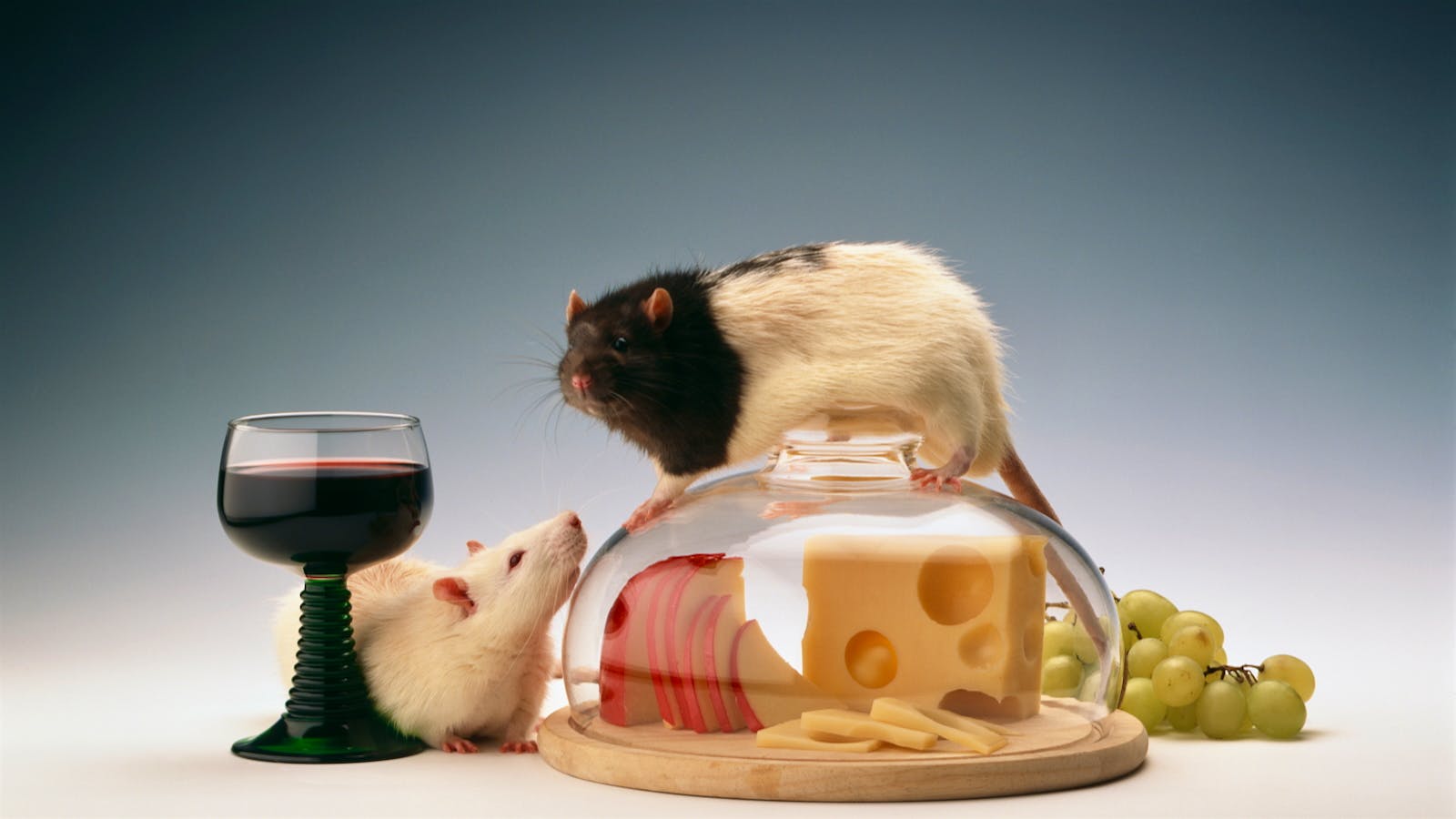


The movie Ratatouille introduced the idea that in some alternate universe a rat could become a chef, cooking haute cuisine. But what about a sommelier? A new study finds that these smart little rodents may also be able to distinguish the differences between various fine wines as well.
Research published in the Journal of Animal Cognition in February by a team of scientists, most of them affiliated with the University of London, has proven that not only are rats able to distinguish between Riesling and Sauvignon Blanc in blind smell tests, but they were also able to recognize different aromatic markers within these wines and identify other wines made from the same grapes. The research proves that nonhuman mammals, such as rats, not only have strong olfactory abilities, but can distinguish between various wines even if they can’t discuss them over dinner among friends.
“Nine rats were trained in an olfactory discrimination task using a specific wine variety [Riesling or Sauvignon Blanc from different winemakers],” wrote the team in their paper. “Rats were then tested using wines of the same varieties to assess their abilities to correctly assign wine to specific categories. Interestingly, all nine rats successfully learned to discriminate between the two varieties.”
Blind Smelling Test
How do you train rats to smell wines? Sadly, no Riedel glasses or aroma wheels were involved. The researchers selected four different Sauvignon Blancs, from France and Chile, and four Rieslings from Germany, France and Austria. Each rat was placed in a test chamber equipped with an odor delivery system that contained a wine in a paper cup. First, the scientists gave the rat a treat when one type of wine was present, teaching it to differentiate between the aroma of a wine attached to a reward when compared to the aromas of other wines.
Then, after the training came the testing. The scientists put the rats back in the chamber and offered the chance to smell various Sauvignon Blancs and Rieslings, some of which the rats had been trained on and some of which were new wines. The rats’ ability to differentiate between grape varieties was determined by whether or not they pressed a lever in response to the wine that had been associated with a reward during training.
Even blindly smelling the wines (although it isn’t as if seeing the labels would have given them a leg up), the rats were able to identify the wines they had been trained on 94 percent of the time and new wines made from the same grape variety 65 percent of the time.
“Our results [...] indicate that a nonhuman mammal can discriminate between complex odor categories,” wrote the team. “This finding is consistent with the idea that many nonhuman mammals have olfactory abilities that match or exceed those of humans.”
The question of whether the rats enjoyed the wine enough to go back for a second sniff is yet to be determined, and whether they would pair it with pizza or pasta is also up for debate. While the scientists decide on where to take their research next, we hope the rats get a chance to further explore their viticultural education, and expand their smell testing to red wines as well as white.