

After checking in on Andy Erickson and Annie Favia’s developing project, I maintained the new calendar/new things theme with another stop in Oakville. This time winemaker Thomas Rivers Brown was my host.
“It’s so incredible to be able to get in on this fruit,” he says.
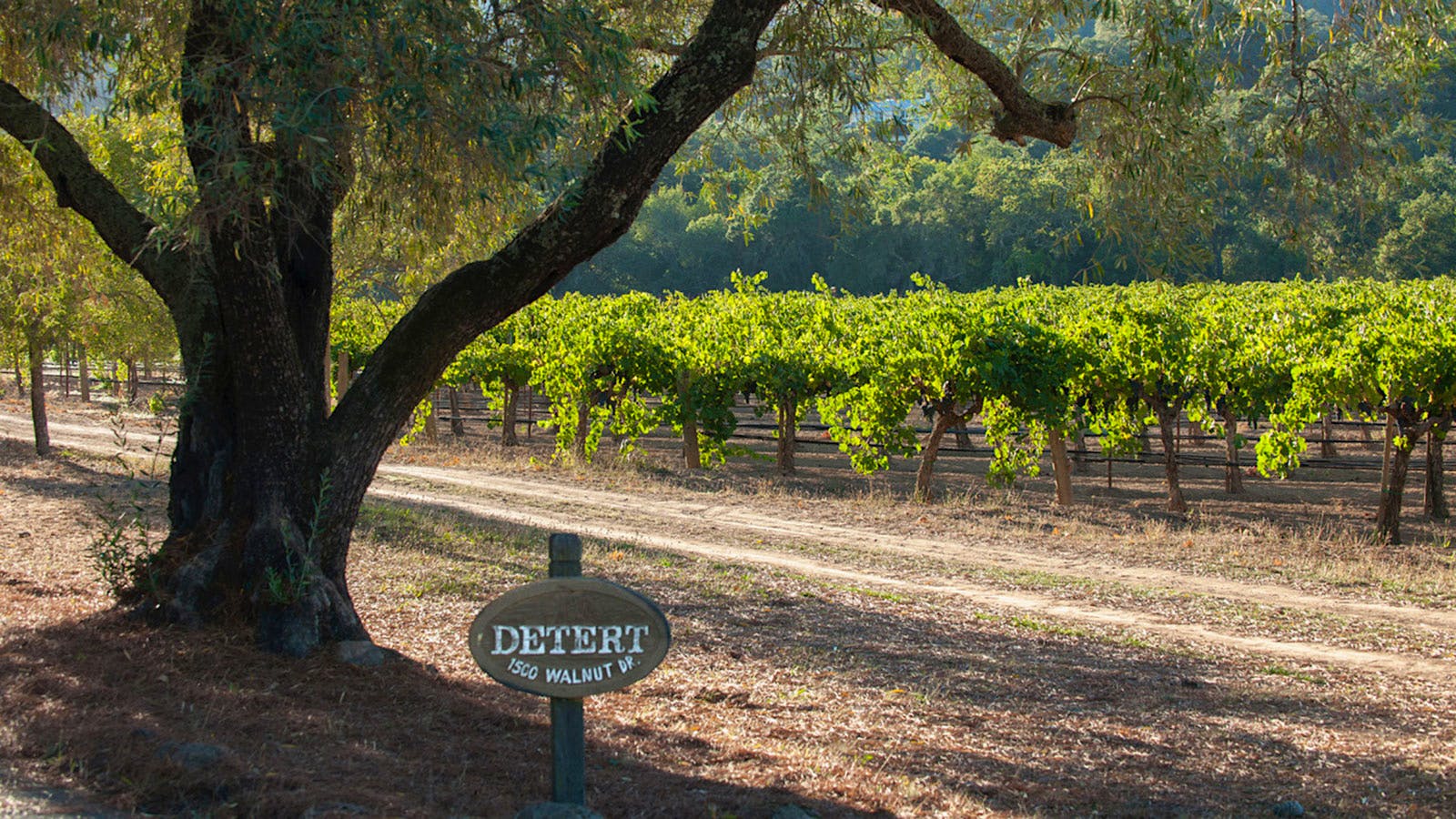
Rivers Brown isn’t prone to hyperbole and “incredible” isn’t a term he uses often. In this case, he drops it in his typical matter-of-fact style as he looks out over the East Block of the Detert family vineyard, a parcel located within the To Kalon vineyard in Oakville. His enthusiasm is understandable. Not very many people have ever had access to Detert family fruit, which, starting with the 2023 vintage, will be the source for Rivers Brown’s new Dorsey label. The project is Rivers Brown’s first ever as solo owner with no outside investors.
Napa History
The Deterts’ old vine Cabernet Franc (planted 1979) in their East Block is arguably the highlight of the historic property. The old vines are interspersed with younger vines planted in 2015 to replace virused ones, using the budwood from the old vines. Those old vines make up about 60 percent of the block, and Rivers Brown is taking fruit from just 25 rows, less than an acre in total. The 2023 vintage yielded a mere 2.1 tons of fruit.
It’s a very small amount of wine, but a very big deal, as the vineyard hasn’t sold fruit to any outside producers other than Robert Mondavi Winery for a long time. The Detert holdings are managed by Tom Garrett, who started his family’s Detert label back in 2000. Detert produces around 750 cases annually for a few Cabernet Franc and Cabernet Sauvignon wines. Garrett is also co-owner and winemaker at Dakota Shy, a négociant-model brand. (Note: Garrett also worked as a tasting coordinator at Wine Spectator from 1995 to 1999.)
The Detert holdings total 18 acres and the site’s vinous history is lengthy. It was first planted in the late 1800s by E.L. Sullivan, then incorporated by Napa legend H.W. Crabb into his To Kalon property in 1891. After Crabb’s death, the land moved through different phases, eventually winding up under Martin Stelling’s ownership in 1943. Stelling’s plantings in 1949 included the two Cabernets as well as some Chenin Blanc. In 1954, Hedwig Detert purchased a 50-acre parcel of To Kalon from the Stelling estate that included those 1949 plantings, and the Detert history began.
![Thomas Rivers Brown in a vineyard.]](https://mshanken.imgix.net/wso/bolt/2026-01/jm-rivers-brown-011526_1600.jpg?auto=compress,format,&sharp=5&vib=20&q=70&w=320 320w,https://mshanken.imgix.net/wso/bolt/2026-01/jm-rivers-brown-011526_1600.jpg?auto=compress,format,&sharp=5&vib=20&q=70&w=320 640w,https://mshanken.imgix.net/wso/bolt/2026-01/jm-rivers-brown-011526_1600.jpg?auto=compress,format,&sharp=5&vib=20&q=70&w=384 768w,https://mshanken.imgix.net/wso/bolt/2026-01/jm-rivers-brown-011526_1600.jpg?auto=compress,format,&sharp=5&vib=20&q=70&w=828 828w)
“Planting Bordeaux varieties back then was pretty rare,” notes Garrett, whose grandfather used budwood from those original Stelling planting to replant the Detert holdings in 1979—those old Cabernet Franc vines that are still going today. (No vines from the original 1949 planting remain, sadly, notes Garrett).
From the mid-1950s through 1965, the Detert family sold their fruit to Robert Mondavi, who was working with his brother Peter at Charles Krug winery. When the Mondavi brothers split, half the fruit went to Peter at Krug and half to Robert at his new namesake winery. By 1969 it went entirely to Robert Mondavi Winery, a relationship that continued after the sale of Mondavi to Constellation in 2004.
(Note: If this all sounds familiar, that’s because it mirrors that of the MacDonald family, who wound up with half of Detert’s original 50-acre parcel. Hedwig Detert’s daughter, Gabrielle Horton, is Graeme and Alex MacDonald’s grandmother.)
An Opportunity For Winemakers
In 2022, the contract with Constellation expired. Garrett knew he could absorb some of the fruit into the Detert label, but there was more than he could handle. So he decided to open up the vineyard to new buyers for the first time in the family’s history.
“It does mean more paperwork, dealing with more people,” says Garrett, with a wry smile. “But it was exciting for us to shift to working with a handful of small, family-owned operations that all have different perspectives on winemaking.”
The new client list that purchased fruit beginning with the 2023 harvest is short and serious: the Harlan family's Bond, Helen Keplinger, Andy Erickson and Annie Favia, plus Morgan Twain-Peterson’s Bedrock.
And Thomas Rivers Brown. Rivers Brown had met Garrett back in 1999 when he was cutting his teeth as an assistant at Turley Wine Cellars. They became friends and the two still team up to help at the local Boy & Girls’ Club. Along the way Garrett helped to bring Rivers Brown on board at Revana in 2011, furthering Rivers Brown’s career.
“I’ve been angling to work with Tom’s site for years,” says Rivers Brown. “We’ve known each other a while and he has always been super supportive of me.”
“It’s been fun getting to work with Thomas again,” says Garrett, who adds that he is learning from Rivers Brown and the other clients’ approaches.
Franc Gets Its Moment
Rivers Brown’s rows sit atop an alluvial fan of gravel soil sloughed off the Mayacamas range over the years, carried by the To Kalon Creek and spread into the typical loam-dominant aspect of the Detert and MacDonald To Kalon parcels. His small slice of the East Block nets a mere 2.1 tons (or 5 barrels) of Cabernet Franc fruit. Rivers Brown is also getting a larger slice of Cabernet Sauvignon, sourced from clone 169 vines planted on St. George rootstock, part of the 2015 replant.
“We didn’t know what to expect with the first wines,” says Rivers Brown, referring to the 2023 vintage. “We kept everything separate and as isolated as possible. From the old and young vine fruit of the Cab Franc to the Cab [Sauv]. Small tanks, pumped over every day, natural yeast, natural malo, just to watch them as closely as possible.”
Cabernet Franc is typically second fiddle to Cabernet Sauvignon in Napa Valley, though in recent years as growing seasons have trended warmer it’s become an increasingly important player, providing both structure and savory aspects. A blend of the two grapes was the understandable initial thought, but as he vinified and aged the wines, Rivers Brown saw a different opportunity.
“For a lot of folks in the valley, the knock on Cabernet Franc is it’s either too tannic, or too green. The beauty is in ’23 nothing got too ripe and everything evolved slowly. So as we watched the lots develop through the élevage, the team realized the Cab Franc was very much its own thing.”
![Detert east block in To Kalon.]](https://mshanken.imgix.net/wso/bolt/2026-01/jm_detert-vineyard-east-block-011526_1600.jpg?auto=compress,format,&sharp=5&vib=20&q=70&w=320 320w,https://mshanken.imgix.net/wso/bolt/2026-01/jm_detert-vineyard-east-block-011526_1600.jpg?auto=compress,format,&sharp=5&vib=20&q=70&w=320 640w,https://mshanken.imgix.net/wso/bolt/2026-01/jm_detert-vineyard-east-block-011526_1600.jpg?auto=compress,format,&sharp=5&vib=20&q=70&w=384 768w,https://mshanken.imgix.net/wso/bolt/2026-01/jm_detert-vineyard-east-block-011526_1600.jpg?auto=compress,format,&sharp=5&vib=20&q=70&w=828 828w)
The result is two distinct bottlings that will debut under Rivers Brown’s new Dorsey label—the name comes from the maternal side of Rivers Brown’s family.
The 2023 Dorsey Cabernet Franc Napa Valley Detert Vineyard Old Vines offers a captivating set of kirsch and plum preserve notes burnished with threads of loam and smoldering tobacco. It’s a deep well of a wine, with evident structure that is remarkably fine-grained. It soaks up its 100 percent new oak with ease, even as it shuts down in the glass as it airs—a sign that patience will be needed. It’s one of the most impressive young wines I’ve tasted and it opens a new window into what Cabernet Franc can do in Napa Valley. Detert’s version of course, along with Colgin’s Cariad and bottlings from Favia and David Arthur have all provided glimpses as well, but it’s a short list.
The Cabernet Franc offers a stark contrast alongside its 2023 Dorsey Cabernet Sauvignon Napa Valley Detert Vineyard brother. The wine hits the glass with a splash of overt red and black fruit liberally tossed with spice box and violet notes. It’s tannic, but markedly brighter in feel, with lively acidity, and a long, streamlined mineral-tinged finish (clone 169 Cabernet Sauvignon is known for its aromatic range and vibrant acidity). It seems to gulp air happily, expanding quickly in the glass while delivering delicious (albeit still-youthful) pleasure.
On the Dorsey label is a Latin phrase ‘quam bene non quantum’.
“Essentially, ‘not how much, but how well’,” says Rivers Brown. With just 330 cases of the Cabernet Sauvignon and one-third that of Cabernet Franc, it makes sense very well indeed.
(Note: Reviews of the wines based on a formal blind tasting will appear in the future.)
Read more of James Molesworth's Winery Intels, hear his interviews with leading winemakers on Wine Spectator's Straight Talk podcast, and follow him on Instagram at @jmolesworth1.