

It may be Dry January, but nonalcoholic drinks have become a year-round fascination. A convergence of evolving lifestyle trends and growing anti-booze activism has pushed overall drinking statistics downward, especially among younger consumers. So it’s no surprise that both established brands and entrepreneurial newcomers have leaped at the opportunity to meet a rising demand for inventive, nonalcoholic alternatives to wine.
Until recently, my experience with de-alcoholized (DA) wines was limited—mainly because I much prefer the real thing. Still, I’m intrigued by the idea of nonalcoholic (NA) beverages crafted for grown-up palates. We’re long overdue for inspired alternatives to juice, soda and tonic—complex, delicious options for when we want a drink without actually wanting to drink. There are a variety of approaches emerging, including creations based on tea, juice or verjus, often with added botanicals, that are nonalcoholic to begin with. For this report, I focused exclusively on de-alcoholized wine: liquid that starts as alcoholic wine and has its booze removed.
These DA beverages, just like good wine, should fulfill a craving for engaging flavors, dynamic textures and a sense of tension and resistance—whether through acidity, bitterness, richness or other distinctive elements. And because different occasions call for different experiences, a broad range of flavors and characters to choose from is called for too.

To see whether currently available de-alcoholized offerings are capable of impressing seasoned wine lovers, we procured 50 bottles from 26 producers and subjected them to our usual blind-tasting methodology. Some of the wines I tasted are produced by large commercial wineries, promising affordability and availability. Others are from makers of fine wines whose traditional bottlings consistently receive solid scores. Roughly a third originate with newer brands. In general, these have been created specifically to empower (or capitalize on) alcohol-free and sober-curious lifestyles—and are often armed with sleek marketing and attractive branding.
An important reminder: Alcohol in wine is not merely a recreational intoxicant. It plays a central role in shaping how we perceive aroma, texture, flavor and sweetness. As an essential chemical ingredient, alcohol affects how our senses perceive the wine in the glass. Producing a successful de-alcoholized wine is therefore a formidable challenge.
What Is De-Alcoholized Wine?
De-alcoholized wine is exactly what it sounds like: wine from which some alcohol has been removed. “Some” is the key word: De-alcoholization can be partial or near-complete, sometimes reducing alcohol levels to below 0.5% alcohol by volume (ABV), which is the legal maximum for a product to be labeled “Alcohol-Free.”
This distinction matters, because wines marketed as “de-alcoholized” are typically not completely alcohol-free. If you’re looking to avoid even trace amounts of alcohol, you’ll be better off sticking with tea- or juice-based options that were never boozy to begin with. There are also producers who deliberately retain a small amount of alcohol (say, 3–7% ABV) as a compromise. The hope is that these wines have a lighter alcohol burden but have been less severely punished by the removal process.
There are vineyards—such as those in northern German regions—that naturally produce wines at lower alcohol levels (8–9% ABV). Elsewhere, vineyard management strategies and winery interventions may be used to reduce potential alcohol, though these approaches tend to thin flavor and structure and can only reduce final ABV so much.
Meaningfully reducing the alcohol of a standard wine requires specialized technology. This typically involves a membrane-based method like reverse osmosis—which was originally developed for water purification—or high-tech distillation machinery like a spinning cone column.
The problem is that these manipulations can remove more than just alcohol. Volatile aromatic compounds can also be stripped away, and processes like vacuum distillation, which expose wine to heat, may result in off flavors. For many wine lovers who value authenticity—a wine’s natural expression of terroir, its varietal character and the graceful guidance of a winemaker’s hand—the prospect of subjecting wine to this kind of deconstruction (or destruction) is unappealing, if not downright unacceptable.
Shifting Tastes and Embracing Moderation
Purists may roll their eyes, but the low- and no-alcohol trend has shown staying power in the market. According to our sibling publication Impact Databank, alcohol-free brands have reported consistent double-digit growth in recent years, and major players like J. Lohr, Fre and Josh Cellars are eager to claim a stake.
Fine wine brands are also stepping in: Catalan icon Familia Torres has launched its own DA project, Natureo, while French Bloom—created by Maggie Frerejean-Taittinger and Constance Jablonski and, as of 2024, backed by LVMH—stands out as a particularly ambitious project, bringing Champagne prices to the 0.0% category.
Luckily for serious wine drinkers who are eager to explore DA wines, specialists have emerged and are embracing the serious pursuit of quality. Tomorrow Cellars was co-founded by Tracy Sweeney, a wine industry executive with two decades of experience in Napa Valley premium brands, along with David Risher, CEO of Lyft, and his wife, author Jen Risher. The brand launched its first de-alcoholized wine in 2024 and has already achieved triple-digit growth.
Consumers, Sweeney told Wine Spectator, are “quickly moving past ‘if’ to ‘which’” when considering the choice to try DA wines as retailers and restaurants expand their inventories. “NA wine will ultimately mirror decaf coffee,” declares Sweeney, “fitting into the same occasions as its full-strength counterpart.”
All the brands I interviewed report that their primary consumers are not strictly sober. “What is perhaps most interesting to us is that the majority of our customers are wine lovers balancing their alcohol intake, rather than sober consumers who abstain entirely,” says Amanda Thomson, CEO and Founder of Thomson & Scott’s “Noughty” brand, which now produces around one million bottles annually.

Thomson observes that the shift in restaurant culture—more beverage programs with nonalcoholic wines and spirit-free cocktails rather than just the standard soft drinks—has dramatically altered consumer perception and captured the attention of those focused on “health, well-being and enjoyment without consequences.” All told, the shifts signal a more open-minded attitude toward modern drinking habits.
The Catena Institute of Wine—founded by Laura Catena of Bodega Catena Zapata—has been releasing de-alcoholized wines as Domaine Elena de Mendoza (“EdeM”) since 2024. Agustín Silva, the project’s winemaker, is energized by recent consumer surveys, which show that a majority of no- and low-alcohol consumers are “alternating between alcoholic and nonalcoholic beverages during a single drinking occasion.
“Most wine lovers encounter situations in which they choose not to drink alcohol,” he adds. “This category responds directly to those moments rather than to a separate consumer group.”

Challenges for De-Alcoholized Wines
Most of the 50 de-alcoholized wines I tasted showed clear signs of heavy intervention, with flavors and textures that didn’t seem believable. Overt resinous notes recurred across many of the wines, including sparklers, whites and reds. That piney quality always stood out as unintegrated and dialed up to a level that suggested fortification with additives more at home in alpine aperitifs.
Some wines aiming for a conspicuously oaky profile showed a sweet spiciness uncomfortably close to spiced rum, complete with artificial notes of vanilla hard candy. One smelled and tasted like a roaring fire. These flavors were likely intended to add complexity but instead highlighted the extent of manipulation.
Many of the wines’ mouthfeels were equally unusual. Acidity was often badly unbalanced and typically countered with an extra dose of sugar, which itself frequently tasted out of whack. This made for a lot of awkward reds.
Sparkling wines fared better, as they naturally carry higher acidity, and consumers are accustomed to Prosecco-like styles with a touch of sweetness. Still whites from highly aromatic varieties like Riesling and Sauvignon Blanc also managed the acid punch, either by approximating an off-dry style through added sugar or because their rambunctious flavor profiles were robust enough to keep pace.
Are De-Alcoholized Wines a True Wine Substitute?
With few exceptions, the degree of winemaker intervention produced a striking uniformity across the 26 brands I tasted. The prevailing impression was that these beverages were engineered and adjusted in the cellar, rather than high-fidelity expressions of vintage, terroir or variety.
This raises a fundamental question: Why base a non-alcoholic beverage on wine at all? In theory, it makes sense to start with wine, but growing grapes, crafting wine, and then de-alcoholizing it is costly and labor-intensive. When the end product tastes like a synthetic approximation, the logic becomes hard to justify.
Silva, the EdeM winemaker, articulates the category’s central dilemma with excellent clarity: “One of our biggest challenges is preventing consumers from directly comparing wines with and without alcohol. Our goal is to communicate that these products are complementary rather than substitutes.”
My tasting convinced me that de-alcoholized wines, as currently made, cannot convincingly stand in for the real thing—and that trying to replicate wine only sets up counterproductive expectations and limits the category’s potential. A more productive approach would be to use wine as a model, but then leave it behind entirely—even as an ingredient—to forge a new, authentic category.

De-Alcoholized Red, White and Sparkling Wines: Which Ones to Try?
These wines are all imposters—and they’re unlikely to fool you—but when approached on their own terms, the best are worth giving a shot and represent the cutting edge of wine-based, nonalcoholic drinks.
Because the variety of styles among the 26 producers sampled was so narrow, my favorites were simply those that struck the most pleasing balance of elements. If you can calibrate your expectations and sample a few of the bottles recommended below, you may find yourself going back for a second glass.
White
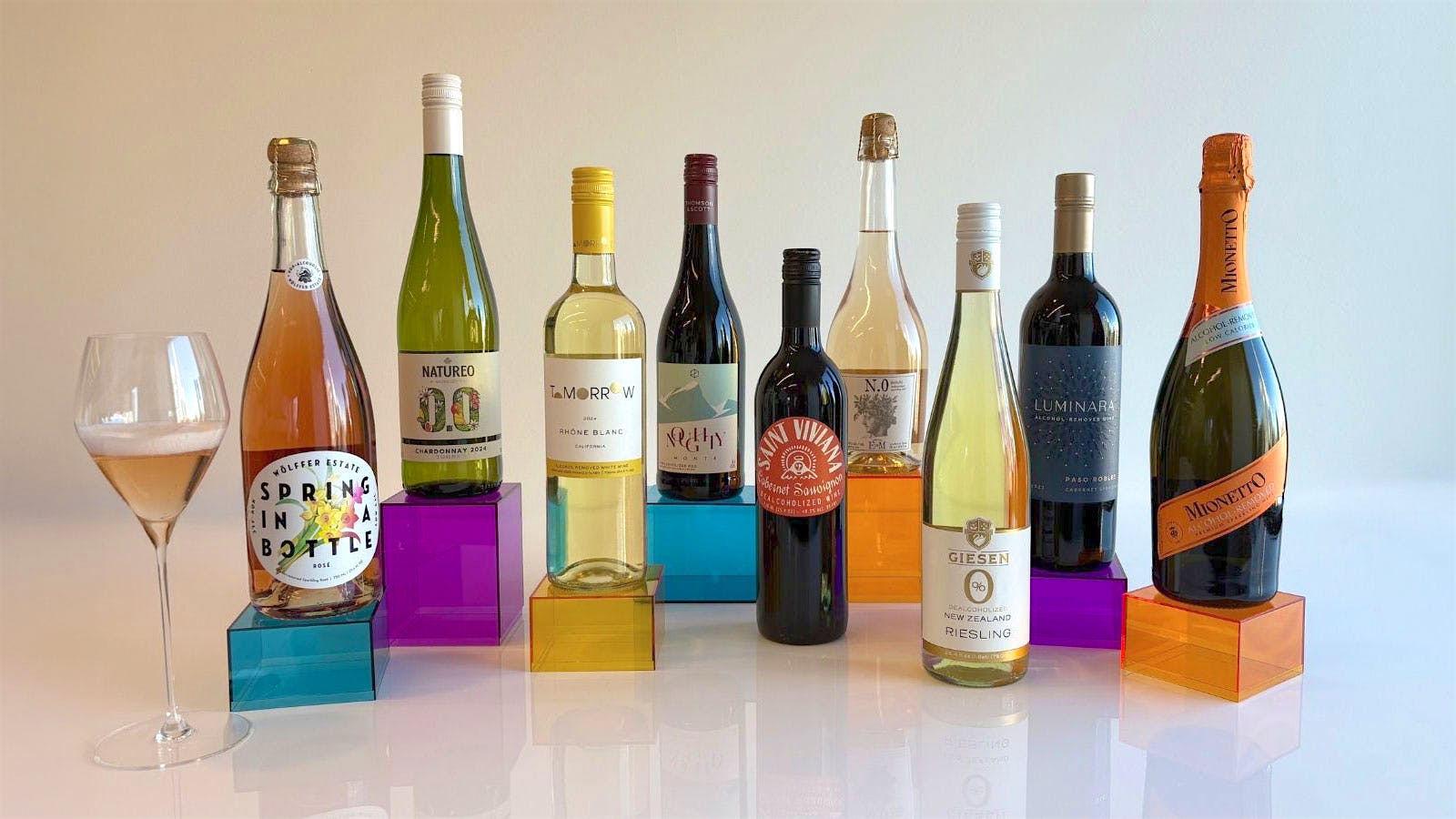
Kim Crawford Sauvignon Blanc New Zealand “Illuminate” Alcohol-Removed: Bursts with tropical notes of passionfruit and kiwi, lifted by a hint of salinity.
Dr. Lo Riesling Germany: Packed with preserved citrus and aloe, this is simple, yet convincingly true to Mosel style. Impressive.
Tomorrow Cellars “Rhône Blanc” California: The richest and roundest of the pack, offering delicate floral and spice accents.
Red
Jøyus Cabernet Sauvignon Washington: Though lightly piney, this has a generous core of fruit. A standout.
Lautus “Savvy Red” South Africa: Dried raspberry and baked cherry meet sun tea flavors. Zesty finish.
Misty Cliffs Cabernet Sauvignon-Merlot South Africa: More structured than the rest, with grippy tannins and well-balanced fruit tones.
Thomson & Scott “Monté” South Africa Noughty: Higher toned, with dried hibiscus and red, black and blue fruit. Tannic pull on the finish.
Sparkling
Domaine EdeM Chardonnay Argentina “Brunette” Botanical-Infused: A notable outlier, resembling a sparkling wine cocktail fortified with bitter Italian vermouth.
Freixenet Spain "Sparkling Rosé": Light cherry and strawberry leaf flavors underscored by a subtle chalkiness.
Giesen Sauvignon Blanc New Zealand “Spritz”: Scented with candied lime and green apple, this finishes off-dry with Moscato-like grapiness.
Mionetto Italy “Premium Sparkling”: Light white peach tea with subtle herbaceousness and a hint of chalkiness.
Wölffer Estate Germany "Spring in a Bottle": Marked by bitter cherry and light herbal tones. Dry, with nice presence and acidity.