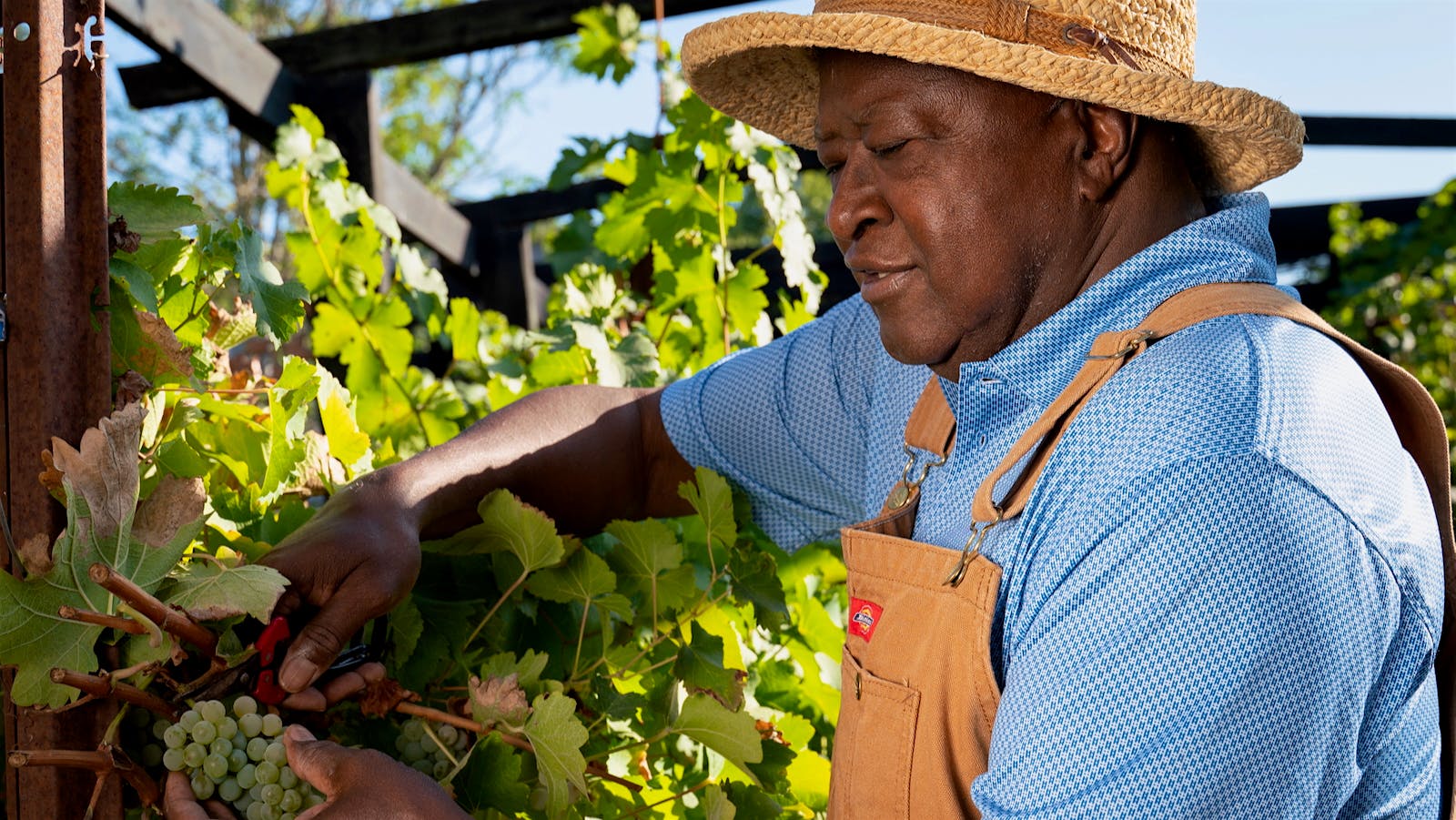


Edward Lee “Mac” McDonald, son of a Texas moonshiner, discovered his passion for wine at age 12 after tasting a bottle of Burgundy. Driven by curiosity and determination, as an adult he moved to California in 1962 and immersed himself in the wine world. His breakthrough came through a mentorship with Charlie and Chuck Wagner of Caymus Vineyards, where he spent 15 years learning viticulture and winemaking.
In 1995, McDonald and his wife, Lil, founded the Pinot Noir label Vision Cellars in Sonoma County. He has produced Pinot Noirs sourced from vineyards throughout the state, routinely earning outstanding ratings.
Throughout his career, McDonald has also been a champion for diversity in the wine industry. In 2003, he co-founded the Association of African American Vintners (AAAV) to promote education and opportunities for underrepresented groups. “Mac made his own success. He is a good man and winemaker, and an excellent speaker,” said Chuck Wagner. “[He] showed the way for others who come from similar beginnings, to forge across racial lines.”
Now, after nearly three decades in the business, McDonald has announced his retirement and the closure of Vision Cellars. He recently spoke with Napa bureau chief MaryAnn Worobiec about his career in wine, his passion for people and Pinot and his decision to step back.
How did you make the decision to close Vision?
Mac McDonald: It’s been good to be in the wine business, but I’m tired. The plan is to get out of the business before I become like an old, worn-out baseball player, or an old rock star that's just hanging on by my teeth. There were goals that I set out to when I got into wine, and I met those goals. So the plan now is to do nothing but gardening.
I have a small amount of inventory because I've been planning this, and I have a tremendous wine club. I didn’t make any wine in 2022, ’23 or ’24 because I anticipated not doing this anymore. I've been winding down for a lot of reasons. One is I want to go out while I'm on top of my game. I want to be like Jim Brown and Rocky Marciano—go out on top.
I've accomplished a lot of goals in my career. That is, [my wife] Lil and I—I always give Miss Lil a lot of credit, because I can't do this stuff without her.
Is there any sadness in your decision?
The only sadness that I may have is I don't have a family member that's interested in doing this.
I don't get too personal about my own personal life. But my boys, neither one of the boys drink, and so they are not a good fit. At one point they thought that they would do it and let the granddaughters be the face out there. [But] they don't really want to do it under the Vision Cellars name, because they don't think anybody could be a Vision Cellars person except me. They don't want to live under my shadow.
The other part is—in wine, no matter what part of it you are in, it’s a lot, a lot of work. They have good jobs, you know, and the grandkids, one's in med school, and one's at Hastings Law School, the other one was in marketing. So they are all doing good, and they don't have to work as many hours as we work.
But the big part for them is that they just don't feel that they could fill the shoes that I'm wearing. And so I applaud them for that. I feel good that they want to be on their own if they want to do something.
I don't mind Vision Cellars dying. And I don't really care to go into selling Vision Cellars. I don't have any regrets about letting it go because I accomplished the goals that I wanted to accomplish and more than the goals that I started out with.
You’ve changed the definition of what a California winemaker can look like. What kind of legacy do you think you’ve left for the African American community?
Many years ago, I had a big feeling that the wine industry could do more to move wine toward everyone. As I went around and I went to all these events, I didn't see enough people that look like me.
Now I see them. So I think I've done that. And I've helped other folks understand how this industry works. You can have the best product—no matter what the product is--but if you don't know how to sell it and advertise it and move it, then you're not going to get there. You're not going to get there no matter how good your product is. I learned that from Chuck Wagner many years ago, so I think I've shared that with a lot of folks.
Over 27 years ago, I started the Association of African American Vintners. I didn't start that as a Black thing. I started that to get more African Americans or people who look like me to drink wine. I didn't care if they bought my wine or not, as long as they were drinking wine. It was about the whole industry.
I think when I was doing that, some folks frowned up on me and told me, “Well, you are dividing the folks.” Well, hell, they were already divided. I'm trying to get them to drink your wine. I'm really proud to accomplish those goals. The Sonoma County Library gives out a scholarship in honor of Vision Cellars every year.
You’ve said you’ve achieved the goals you set out. What were they?
Don't laugh when I tell you this. There were two things I really wanted to do. One of them was that I wanted to have my wine rated by the Wine Spectator. That was big for me. That was really, really big for me.

The other [goal] was, I wanted to have our wine served at the White House. And this has been accomplished many times. They send you this nice, big plaque with what they served for dinner. And what I especially liked about it? It was served during different administrations.
Is there anything else you want to tell the people that have been following your career and buying your wines for all these years?
Don't be afraid of your business dying. Sometimes you want to have a legacy, and you think that legacy is going to last for years. I've tried to help folks understand you gotta do more than bottling some wine and slapping your name on it. You can call yourself a winemaker, that's the easy part of it. It’s harder when you have to make it and sell it and market it.
You just can't go out there and buy a shiner [a bottled wine without a label] and put a label on and say you're a winemaker. Anybody can do that. But what are you going to do once you get that on there? Not enough folks really understand the business to begin with.
You said that you were looking forward to gardening. Do you have a big garden?
I've always had a year-round garden at my house. Our house is on a half acre lot, so I love growing.
Growing up in the sticks of Texas, you didn't have a Costco or Walmart or Safeway. You didn't have all of those fancy stores, you had to grow all your stuff in your garden. I look back on my life, I'm sure glad that I grew up the way I did. I'm so happy that I grew up in the woods without all this luxury stuff, you know, and all this convenient stuff.
And quite frankly, I never got away from it. Each year I try to find something I never have grown. This year I grew sweet potatoes. I never grew sweet potatoes, but I recall back when my parents used to do it.
Lil don't like sweet potatoes, so I just grow them and give them to my neighbors.