

Visitors to Napa Valley this year will have a hard time escaping a certain anniversary. While America celebrates its 250th birthday, California is celebrating 50 years since the tasting that became known as “the Judgment of Paris” opened the world’s eyes to California’s progress and promise.
To mark the anniversary of the tasting, held on May 24, 1976, Stag’s Leap Wine Cellars, whose red wine topped the judging, is hosting several events throughout the year, including dinners in multiple cities and a weekend of seminars at the winery in October. They’ll also be opening multiple old vintages from their library all year, including a few remaining bottles of the 1973 wine that won. Château Montelena has already sold out of tickets for its May dinner commemorating its Chardonnay’s victory.
In Washington, the Smithsonian hosted a dinner in April featuring three of the wineries. Want to taste the wines that the judges did? ShuttleCork, a food and wine auction in Kansas City that benefits the Nelson-Atkins museum and art education for kids, is auctioning off all the Napa reds and the Montelena Chardonnay, from the same vintage as those included in the tasting. In a rather … unique tribute, Festival Napa Valley is presenting a one-act opera on the Judgment in July.
![Stag’s Leap Cabernet Sauvignon 1973.]](https://mshanken.imgix.net/wso/bolt/2026-05/ns_paris-judgment-stags-050126_1080.jpg?auto=compress,format,&sharp=5&vib=20&q=70&w=320 320w,https://mshanken.imgix.net/wso/bolt/2026-05/ns_paris-judgment-stags-050126_1080.jpg?auto=compress,format,&sharp=5&vib=20&q=70&w=320 640w,https://mshanken.imgix.net/wso/bolt/2026-05/ns_paris-judgment-stags-050126_1080.jpg?auto=compress,format,&sharp=5&vib=20&q=70&w=384 768w,https://mshanken.imgix.net/wso/bolt/2026-05/ns_paris-judgment-stags-050126_1080.jpg?auto=compress,format,&sharp=5&vib=20&q=70&w=828 828w)
But whether you’re attending any special events or not, anyone who loves wine should take a moment to ponder what the tasting meant and consider how far Napa Valley has come in those 50 years. For Napa’s dynamic growth since has mirrored the wine world at large. And while the tasting in a Paris hotel gets a lot of credit for it, the real hero of the story is California.
No Revolution Planned
The late Steven Spurrier, who organized the tasting, often said he wasn’t trying to change the wine world. He was mostly hoping for a fun event and to open French eyes to how good California wines were. A carefree Englishman who had fallen in love with France, Spurrier had built a successful business running a wineshop in Paris, primarily catering to fellow ex-pats.
Most French didn’t think too hard about wine purchases—they drank what their parents drank—but the ex-pat community wanted to learn about wine, and so Spurrier opened a wine school, L’Académie du Vin, next to the shop. The school thrived. (Still open, L’Academie is publishing a book on the tasting this year.)
That educational spirit inspired the tasting. Spurrier kept hearing that California wines were improving, particularly from his American co-worker, Patricia Gallagher. But the French, whose view of wine was frozen in amber, were not interested. As a publicity exercise for the school and shop, the pair decided to host a tasting of California wines in Paris, timed to celebrate the U.S. bicentennial. After all, it was the French who had helped America win its independence. They invited leading media organizations in Paris, including local wine writers. Only George Taber, Time’s Paris bureau chief (who had taken a course at L’Académie), showed up.
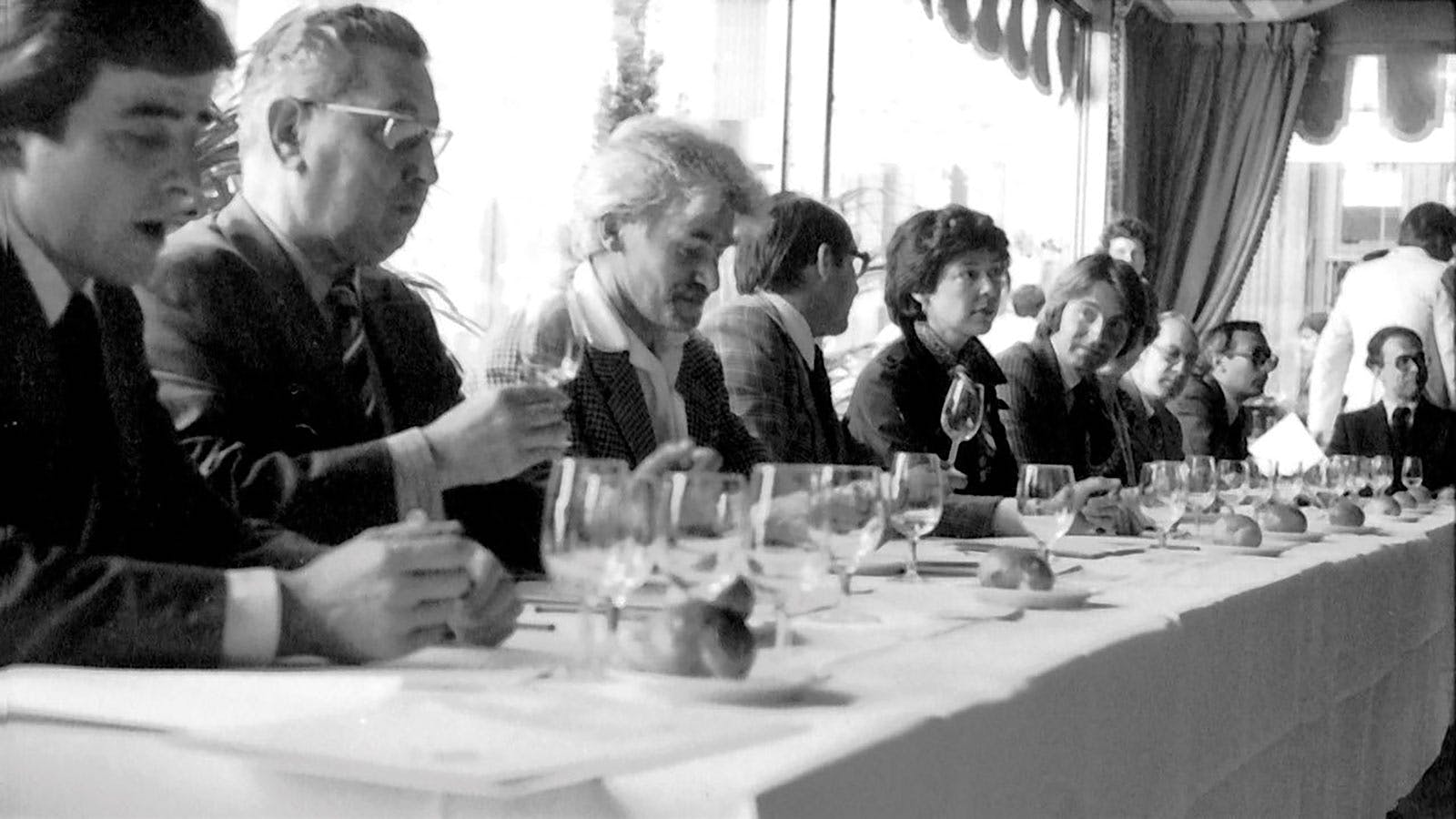
The tasting was blind, to avoid inherent bias, but the setup—one flight of California Chardonnays and white Burgundies, one flight of California Cabernets and red Bordeauxs—held a fundamental flaw. Spurrier originally told his judges they would just be tasting California—he did not mention there would be French wines until the tasting was about to begin. This curveball led the judges to spend much of the tasting debating the origins of the wines, rather than the quality.
![Judges at the 1976 Paris Tasting.]](https://mshanken.imgix.net/wso/bolt/2026-05/ns_paris-judgment-odette-050126_1600.jpg?auto=compress,format,&sharp=5&vib=20&q=70&w=320 320w,https://mshanken.imgix.net/wso/bolt/2026-05/ns_paris-judgment-odette-050126_1600.jpg?auto=compress,format,&sharp=5&vib=20&q=70&w=320 640w,https://mshanken.imgix.net/wso/bolt/2026-05/ns_paris-judgment-odette-050126_1600.jpg?auto=compress,format,&sharp=5&vib=20&q=70&w=384 768w,https://mshanken.imgix.net/wso/bolt/2026-05/ns_paris-judgment-odette-050126_1600.jpg?auto=compress,format,&sharp=5&vib=20&q=70&w=828 828w)
There was also the panel format—judges rated the wines on a 20-point scale, and Spurrier averaged all the scores afterward. This obscured the wildly different rankings from each judge. Stag’s Leap earned only two first-place scores, but enough third and fourth places to put it on top. (Odette Kahn, editor of Le Revue du Vin, who did rank Stag’s Leap number one, was dismayed by the results. She unsuccessfully demanded her scorecard back and never spoke to Spurrier again.)
California Revealed
Most wine experts knew the tasting was interesting, but hardly earth-shattering. But the American media, picking up on Taber’s article, knew a good story when they saw one. Even this magazine, which was less than three months old, reported “California Wines Top French.”
Still, crediting the Paris Tasting with putting California wine on the map is like crediting Sideways for the incredible quality revolution of California Pinot Noir of the past 40 years.
The tasting merely called attention to a seismic change that had been building for decades. Starting after Prohibition, there were stubborn rebels like Louis Martini, Leland Stewart and John Daniel who persevered in making quality wine. There were innovators, like Robert Mondavi, who looked at a valley filled with plum trees and somehow saw an American wine revolution. (It’s unsurprising that the two winemakers who made the winning wines in Paris, Warren Winiarski and Mike Grgich, previously worked for Mondavi.) There was the young new wave of folks like Winiarksi, who moved to Napa in the 1960s with a dream of making that revolution happen.
The idea that there was a wine world beyond France had also been quietly building. Baron Philippe de Rothschild first discussed forming a joint California venture with Mondavi in 1970, six years before the tasting. But after Paris, things moved quickly. Opus One was formed in 1978. Christian Moueix arrived in Napa around the same time. And soon, other New World regions—Australia, Chile and Argentina—were being recognized and collaborated with too.
In 2007, Italy’s Antinori family purchased a 15% stake in Stag’s Leap. In 2023, they took full ownership. The idea that an Italian wine dynasty would invest in Napa was no longer revolutionary. California wine has changed in the past 50 years, and with it, the world. Wine still has appellations, but it doesn’t truly have borders anymore.
Mitch Frank, senior editor for news, has been with Wine Spectator since 2005. Stay on top of important wine news stories and opinion columns with Wine Spectator’s free Breaking News Alerts.