

A quiet revolution is growing in the vineyards of Champagne. For the first time in the appellation's modern history, a disease-resistant hybrid has been authorized by appellation authorities. Its implications reach far beyond the chalky hillsides of the Marne.
Voltis, a hybrid grape developed through a collaboration between INRAE (the French National Research Institute for Agriculture, Food and Environment) and Germany’s Julius Kühn Institute, was approved for use in Champagne at the end of 2022 under France’s VIFA framework (Varieties of Interest for Adaptation), which allows regions to experiment with new grape varieties. Regulators authorized the first plantings in 2023.
Why plant a new grape? Voltis is genetically resistant to both downy mildew and powdery mildew, the twin fungal scourges that have long troubled viticulture in humid northern climates. Those scourges often lead growers to spray chemicals on their vines.
"You have to see Voltis as one element of the toolbox," explained Géraldine Uriel, who heads the Comité Champagne’s plant material and production service and has overseen the variety's evaluation since experimental plantings began in 2010. "We need to reduce phytosanitary treatments as much as possible. The vineyards near houses, on steep slopes—these are examples of situations where Voltis will be particularly relevant.”
The grape’s mildew resistance is not incidental. Researchers bred multiple grape varieties, including American grapevines such as Vitis rotundifolia, aka Muscadine, to create Voltis. The variety retains approximately 95% Vitis vinifera genes through successive backcrossing, a ratio that qualified it for regulatory purposes as a vinifera variety in France and opened the door to being allowed in wine appellations.
A Trial by Terroir in the Côte des Bar
The team at Drappier, one of the Aube's most celebrated Champagne houses, is closely watching how Voltis does. Hugo Drappier planted roughly 40 Voltis vines in 2023. He opted to locate them on Kimmeridgian Jurassic limestone rather than the chalk soils where all prior trials had taken place.
"Voltis had been planted in chalk soils, around Épernay" in trials, he said. "But since our vineyard is in the Côte des Bar, I wanted to form my own opinion.”
The 2025 harvest, Drappier's first pressing, is modest in volume but rich in observation. They produced one feuillette, a roughly 114-liter half-barrel. "No disease at all, strong vigor," he noted. "The leaves stay green very late into the season, because the vine isn't affected by downy mildew. That means very good reserve buildup."
The Drappier team’s tasting notes point to neutral aromas, which Drappier considers a feature rather than a flaw: "It's rather neutral, not very aromatic. That's good, we're not looking for powerful, aromatic varieties.”
Anthony Lacroix, of Champagne Lacroix in Châtillon-sur-Marne, planted Voltis near residential buildings and agrees that the variety is useful because it allows for less fungicide. "Voltis is interesting because it addresses a societal issue,” he said. “I planted it near a house, and the characteristic of this variety allows me to drastically limit phytosanitary products."
For Drappier, a fully certified organic producer, the variety's practical value lies not in protecting neighboring vines—"downy mildew is everywhere anyway," he said—but in reducing the estate's average copper use. France has tightened restrictions on copper sprays, which have been organic winemakers’ last line of defense against mildew, so the need to find alternatives has never been greater.
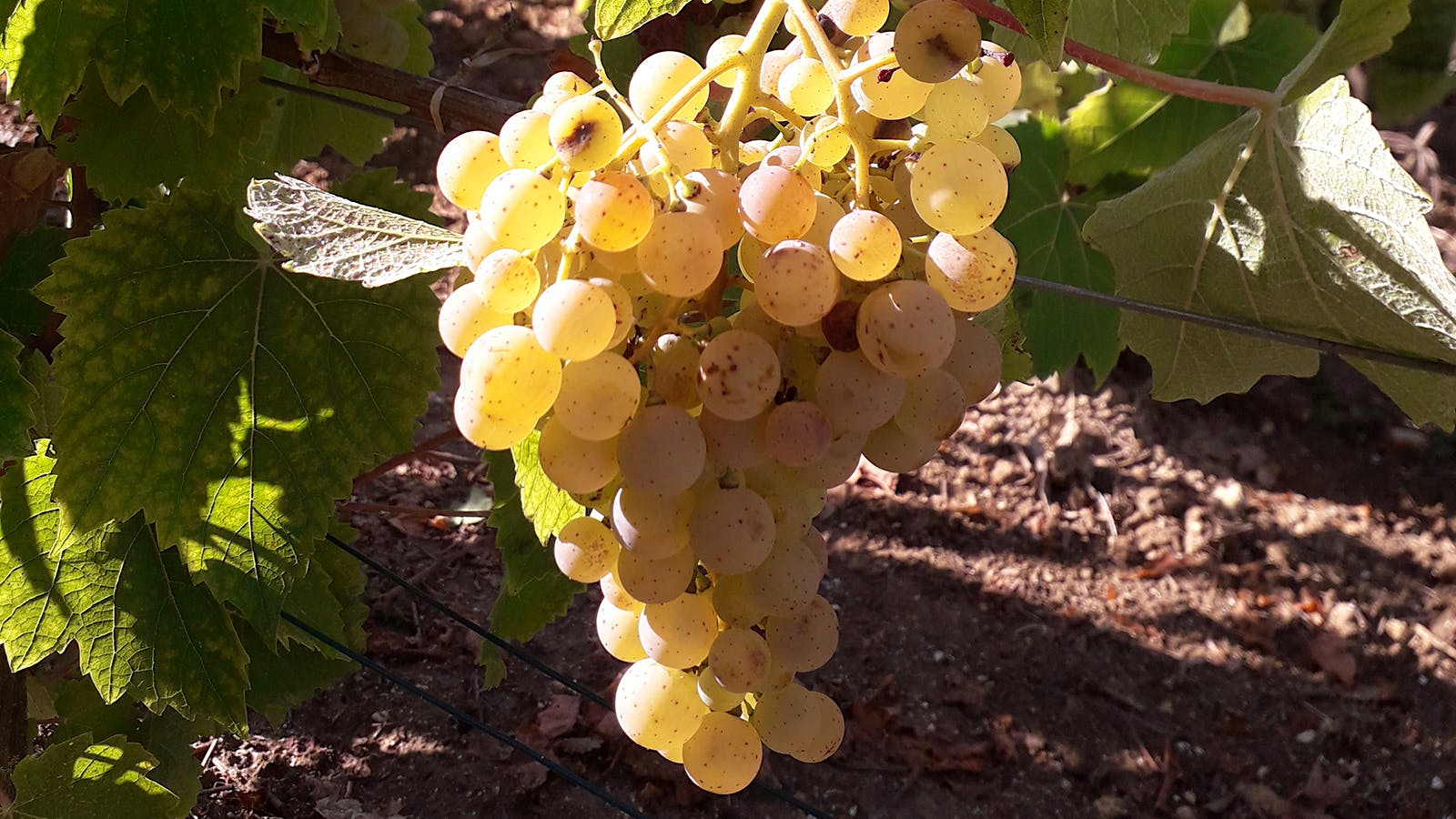
![A bunch of Chardonnay rosé.]](https://mshanken.imgix.net/wso/bolt/2026-03/ns_champagne-grapes-chardonnay-rose-033026_1080.jpg?auto=compress,format,&sharp=5&vib=20&q=70&w=320 320w,https://mshanken.imgix.net/wso/bolt/2026-03/ns_champagne-grapes-chardonnay-rose-033026_1080.jpg?auto=compress,format,&sharp=5&vib=20&q=70&w=320 640w,https://mshanken.imgix.net/wso/bolt/2026-03/ns_champagne-grapes-chardonnay-rose-033026_1080.jpg?auto=compress,format,&sharp=5&vib=20&q=70&w=384 768w,https://mshanken.imgix.net/wso/bolt/2026-03/ns_champagne-grapes-chardonnay-rose-033026_1080.jpg?auto=compress,format,&sharp=5&vib=20&q=70&w=828 828w)
Built for Caution, Designed for the Long Game
Current regulations allow Champagne growers to plant Voltis in up to 5% of their vineyard area and they can use up to 10% in any blend. Uriel describes these limits not as constraints, but as deliberate architecture. "We plant a vine for more than 40 years, so changes happen in small steps.”
After a 10-year trial window, Champagne's professionals will assess whether to expand, maintain or end the experiment. Blind tastings conducted in 2023 with nearly 700 experts found blends incorporating 5% Voltis were perceived as "rounder, simpler and more ready to drink,” the panel reported.
At present, 170 parcels have been planted by cooperatives, houses and growers. And Voltis is not traveling alone: two additional mildew-resistant varieties, Aurelis and Cérélis, are being tested and could be approved around 2027. Also, a joint Champagne-Burgundy program called CEPINOV is evaluating nearly 400 experimental grapes, crossing Chardonnay and Pinot Noir with disease-resistant varieties to develop purpose-built varieties for both regions' terroirs. Uriel emphasizes that they are creating these new grapes through the traditional method of crossing existing types, not genetic modification.
An old grape has also been reauthorized. Chardonnay rosé, a pink-berried mutation of Chardonnay documented in Champagne since around 1900, was effectively erased from the specifications by a bureaucratic oversight years ago. The authorities formally reapproved it in 2025. "It's the rehabilitation of a heritage cépage that had been forgotten," said Uriel.
The first Champagnes incorporating Voltis in the blend are expected around 2027 or 2028. Hugo Drappier cautions that experimentation moves slowly in a centuries-old wine region. "Pinot Noir has been planted in the Aube for over 900 years and we learn every day. So for Voltis, if we want to know what it's like, we have to start somewhere.”
Paige Donner is a Paris-based journalist who has written for the New York Times and the Los Angeles Times.
Stay on top of important wine stories with Wine Spectator’s free Breaking News Alerts.