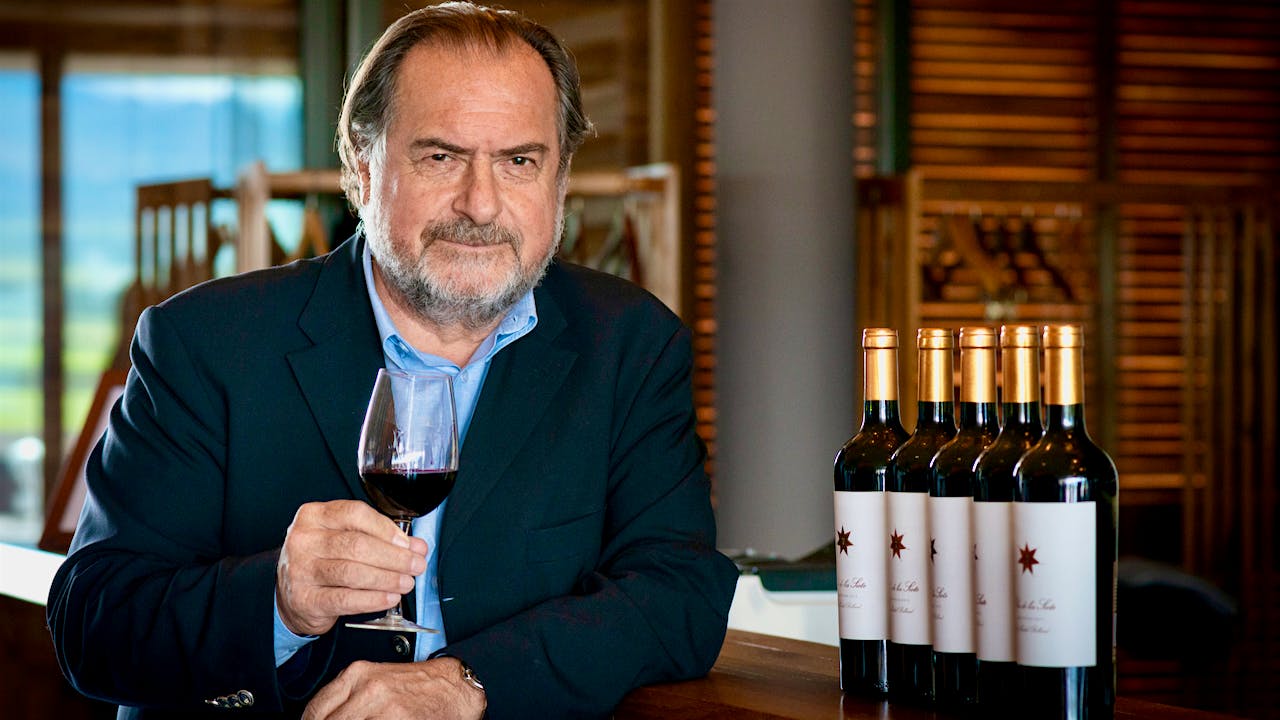


Michel Rolland, the Bordeaux-based winemaker and consultant whose influence spread out from his laboratory in Libourne, Bordeaux, to encompass bottlings of wine from all corners of the world, died in the early hours of March 20 from a heart attack. He was 78.
At his career height, from the mid-1990s through the early 2000s, Rolland was arguably the world’s most in-demand wine consultant, helping Bordeaux regain its prominence after the doldrums of the 1970s before becoming a driving force for the emergence of Napa Valley “cult” Cabernets and more, including Harlan, Araujo, Dalla Valle and even Robert Mondavi Winery. He also owned properties in Bordeaux and developed a project in Argentina, all while consulting with clients in South America, Italy, Spain, South Africa, India, Croatia, Israel and more. His peripatetic nature helped spawn the term “flying winemaker.”
“We worked with him for 38 years. At times there was tension between what we thought were the best wines. But that tension was good because we were both always in pursuit of what the best wine was,” says Bill Harlan. “He made tremendous progress for Napa Valley of course, and for wine as a whole.”
Rolland was most often lauded for his blending skills, which led many of his clients’ wines to feature a glossy, polished and generous feel with copious, hedonistic cores of fruit. Over time, detractors felt his style was heavy-handed and homogenizing, minimizing terroir. He remained active in his lab until 2020 and continued with close clients and his own projects, but that signature style was considered less and less in vogue.
Roots on the Right Bank
Rolland was born at his family’s Château Le Bon Pasteur on Dec. 24, 1947. He grew up immersed in Bordeaux’s Right Bank culture during the 1960s and 1970s, a veritable world away from the blue-blood culture of the Médoc on the other side of the river. He studied enology at Bordeaux’s Institut d’Oenologie and graduated in 1972. His wife, Dany, whom he married in 1970, was in the same graduating class.
With Dany, Rolland started his laboratory for wine analysis in the town of Libourne in 1973. Rolland & Associés would become synonymous with the man himself.
Rolland’s first client outside of Bordeaux was Simi winery in 1987, where Zelma Long was the winemaker at the time. Her right hand was a young Paul Hobbs, with whom Rolland then connected with on a trip to Argentina the next year.
“I was in Argentina and talking with Nicolás Catena at the time,” recalled Hobbs. “Rolland was working with [Bodegas] Etchart then, so Nicolás and I went up to see him in Cafayate. We had lunch together and he joked that I would be the number one consultant if it weren’t for him. He loved to joke and he was always good natured.
“His main skill was his prodigious ability to blend,” said Hobbs. “From the crack of dawn through lunch, without getting up, he would work and work and work. He was really truly amazing at that, and I learned a lot from it.”
Through the 1980s and 1990s Rolland primarily developed his consulting business in both California and Argentina. In Argentina, he influenced producers to polish and accentuate the flattering fruit profile of Malbec while eliminating the rusticity in many of the wines at the time. Argentine Malbec became a hot category in the U.S. market during the 1990s. Rolland felt so strongly about Argentina’s potential, he eventually set up his own project there as well.
“We discovered Argentina in 1988,” Dany told Wine Spectator this morning from Argentina, where she had been with Michel days prior. “We had a quick heart for it. The families here and the joy for life made us fall in love with the place. At that time, the wineries were having trouble getting into the U.S. market. The importers said they couldn’t sell the wines with the taste they had at the time, so Michel began to consult with properties in Argentina.”
Michel and Dany would go on to purchase a 24-acre parcel of old-vine Malbec in Vista Flores and later developed a larger site with partners from Bordeaux, calling it Clos de los Siete.
“Everywhere he went, he made friends. Even with people he didn’t work with, like me and my dad, as we never hired him as a consultant,” said Laura Catena, of Argentina’s Bodegas Catena Zapata. “He was the most coveted wine consultant in the world. It made me very proud that he had chosen Argentina so deliberately.”
Owning Wineries
Even as he traveled extensively, Rolland remained rooted in his native Bordeaux. Along with his brother Jean-Daniel, Rolland assumed control of the family’s Château Le Bon Pasteur in Pomerol in 1978 (their grandparents purchased it back in 1920). Along with Dany, he purchased Château Fontenil in Fronsac in 1986.
Rolland eventually sold a majority ownership of his family’s Bordeaux properties—which included Château Rolland-Maillet in St.-Emilion and Château Bertineau St. Vincent in Lalande-de-Pomerol—to Hong Kong’s Goldin Group in 2013, though he continued to oversee production. (Dany continues to own Fontenil.) Rolland & Associés would remain the hub for his influential consultancy up until he sold his majority share in 2020.
Julien Viaud, one of the co-owners of the consultancy today, joined the lab in 2006, eventually becoming Rolland’s closest deputy. “The reality is, he was a child of the countryside,” said Viaud. “His father and grandfather were farmers and viticulturists. He was very pragmatic and that was the most important lesson I learned from him. People will say he made wines a certain way, but when we would make the blends, he would choose on logic, not other influences. Sometimes I could think too much, and he taught me the best way is the simple way, the pragmatic way. He taught me to understand the terroir, and take the wine as it is.”
In time, the style most associated with Rolland—perhaps most typified by Napa Valley Cabernets from the late 1990s through the early 2000s, which leaned into ripeness, extraction and obvious new oak élevage—began to lose some of its popularity. After 2010, prominent estates in Bordeaux, including Château La Gaffelière and Château Pavie-Macquin, parted ways with the consultant, aiming to shift their wines to a style that featured more restraint and freshness.
Overall, however, his influence on the generation of winemakers and their wines that followed after him remains. And his role as a winemaker who traveled between multiple nations helped bring technical expertise to the wine world and shrink its boundaries.
“He helped us so much in the direction of our winemaking. Nobody was better,” said Shari Staglin, whose family-owned winery in Rutherford had worked with Rolland since 1999.
Rolland is survived by his brother Jean-Daniel, his wife, Dany, their two daughters, Stéphanie and Marie, and five grandchildren.
Stay on top of important wine stories with Wine Spectator’s free Breaking News Alerts.