

Italian vintner Antonio Capaldo is looking to the past to see the future of wine—specifically in cultivating grapes, making wine and hosting tastings in and around the beautifully ornate ruins of ancient Pompeii, one of Italy’s most evocative and visited destinations.
“We wine producers feel under attack now, but this is an opportunity to talk about the things that make wine special,” he told Wine Spectator, surrounded by scaffolding on the relatively new archaeological excavation of a colorfully frescoed villa called the House of Thiasus, dedicated to the cult of Bacchus.
“We have to talk about culture and wine. It’s what will save us in the future,” added Capaldo, chairman and president of the Tenute Capaldo Group, which is anchored by Campania’s Feudi di San Gregorio winery and includes several wine estates across southern Italy.
Capaldo’s new “Wine Archaeology” project, selected as a unique public-private partnership by the Pompeii Archaeological Park in 2025, aims to marry wine and history in unprecedented ways. In a time of wine business doldrums, this 19-year agreement pledges to create a new style of wine tourism combining visits to wine-centric sites—like the House of Thiasus and the vestiges of ancient taverns—with explanatory vineyard walks, winery tours and tastings. All of it will be in the public lands of “Greater Pompeii,” famously destroyed and buried by an eruption of Mount Vesuvius in 79 C.E.
“The idea is Pompeii as not only a traditional kind of visit, but a visit that will allow people to interact with the site in a different way,” said Pompeii Park director Gabriel Zuchtriegel. “It’s a different kind of archaeology.”
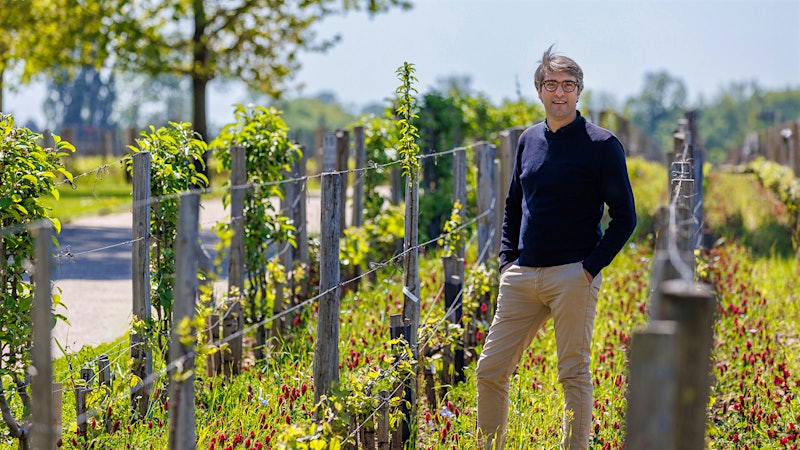
![Antonio Capaldo.]](https://mshanken.imgix.net/wso/bolt/2026-04/ns_pompeii-vineyard-antonio-041026_1600.jpg?auto=compress,format,&sharp=5&vib=20&q=70&w=320 320w,https://mshanken.imgix.net/wso/bolt/2026-04/ns_pompeii-vineyard-antonio-041026_1600.jpg?auto=compress,format,&sharp=5&vib=20&q=70&w=320 640w,https://mshanken.imgix.net/wso/bolt/2026-04/ns_pompeii-vineyard-antonio-041026_1600.jpg?auto=compress,format,&sharp=5&vib=20&q=70&w=384 768w,https://mshanken.imgix.net/wso/bolt/2026-04/ns_pompeii-vineyard-antonio-041026_1600.jpg?auto=compress,format,&sharp=5&vib=20&q=70&w=828 828w)
Director of the Pompeii site for five years, Zuchtriegel believes in wine as a historical, spiritual and social good—beyond modern efforts to objectify or demonize it. “In some countries they are planning to put warning labels on wine like it’s some kind of drug,” he said. “Wine is about the culture of sharing and combining with food, and the Romans knew this.”
Wine’s sanctity is fully on display at the House of Thiasus, constructed around a spectacular room discovered in early 2025 featuring life-sized frescoes (dated 40-30 B.C.E.) of a Bacchanalian procession with dancing devotees, hunting scenes and a mortal woman undergoing initiation to the cult. The house will serve as inspiration for the project, though Capaldo has yet to choose a name for the winery and wines.
History and Laboratory
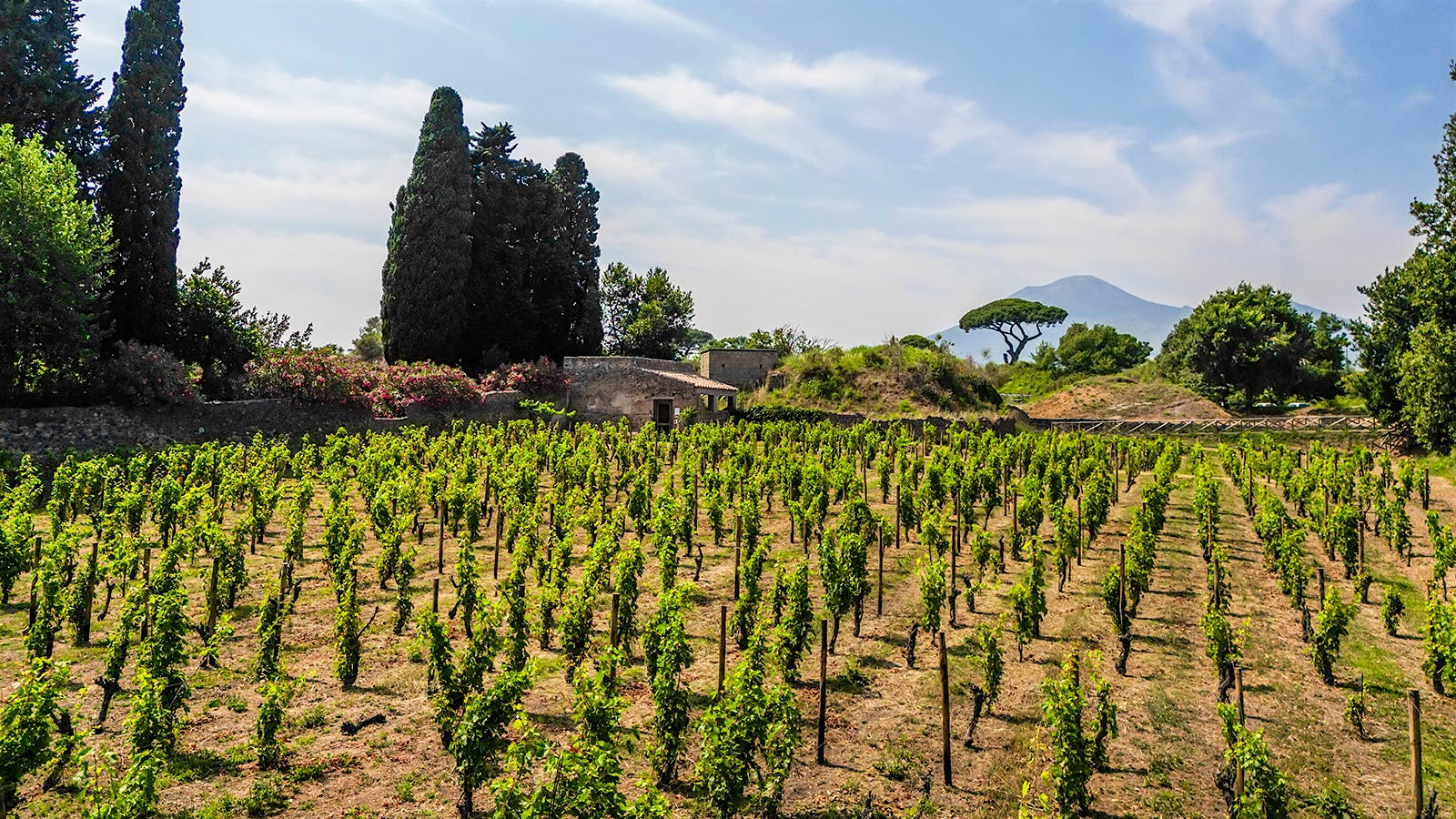
Capaldo and his team aren’t the first to practice viticulture here. About 2.5 acres of vineyards were planted in the park starting in 2000 by Feudi’s Campania competitor Mastroberardino, which maintained a 21-year license.
Here in Pompeii, seated at the base of Mount Vesuvius a couple of miles from the Gulf of Naples, Mastroberardino cultivated red local varieties Piedirosso, Aglianico, Sciascinoso and more across 14 tiny parcels and used the fruit in its Villa dei Misteri red blend (named for an earlier discovered Bacchus-themed villa in Pompeii). The wine was produced in tiny quantities off-site.
The new project led by Capaldo takes over those vineyards while broadening and deepening Pompeii’s modern relationship with wine. As early as this fall, a small tasting room in an antique outbuilding is planned to open next to a working vineyard. That space and others will eventually be used to age wine in amphorae.
Well before the release of the first wines, in 2030, Capaldo will also construct a modern winery on the site of the nearby ancient Roman Villa San Marco, 4 miles to the south of Pompeii on the park’s satellite site in Stabia.
![A vineyard in Pompeii.]](https://mshanken.imgix.net/wso/bolt/2026-04/ns_pompeii-vineyard-project-041026_1600.jpg?auto=compress,format,&sharp=5&vib=20&q=70&w=320 320w,https://mshanken.imgix.net/wso/bolt/2026-04/ns_pompeii-vineyard-project-041026_1600.jpg?auto=compress,format,&sharp=5&vib=20&q=70&w=320 640w,https://mshanken.imgix.net/wso/bolt/2026-04/ns_pompeii-vineyard-project-041026_1600.jpg?auto=compress,format,&sharp=5&vib=20&q=70&w=384 768w,https://mshanken.imgix.net/wso/bolt/2026-04/ns_pompeii-vineyard-project-041026_1600.jpg?auto=compress,format,&sharp=5&vib=20&q=70&w=828 828w)
In early March, Tenute Capaldo’s consulting agronomist Pierpaolo Sirch led the planting of 10 acres of vineyards for white and red grapes on park lands in the countryside outside the ancient city walls, where archaeologists believe country villas once produced wine, olive oil and agricultural products for the city. The vineyards are propagated from old-vine cuttings and planted without grafting to rootstock. Ungrafted viticulture is a modern rarity that is illegal in some areas for crop safety, but volcanic sands like those of Pompeii are viewed as practically immune to vineyard soil pests like phylloxera. The team plans to farm the site organically.
Sirch said the project will deploy a number of traditional and rare training systems from across southern Italy—from head-trained gobelet forms to different styles of high trellises to ancient forms of cultivation such as alberata and maritata, in which vines are trained to trees. Each of these systems evolved over different periods and climate epochs that included long periods of devastating drought or overwhelming rains.
“For us it’s not about just making wine in Pompeii. It’s about things we will discover,” said Sirch. “This must be a laboratory. To understand where we’re going, we need to understand where we came from.”
Two Intriguing Wines
Before Pompeii became a Roman colony it was a Greek and Etruscan settlement, and both those cultures contributed to its viticulture. “The Greeks were more merchants and the Etruscans were farmers,” said Sirch. “Those two cultures met in Pompeii. The Etruscans [from what is now central Italy] cultivated vines in forms that were expansive. The Greeks developed an agriculture of drought, and they cultivated vines that were lower and more compact.”
Ultimately, Capaldo plans for 17 vineyard acres to yield about 1,700 cases of red and 800 cases of white wine per year, to be sold primarily at the new winery and Pompeii tasting room. Though an existing Pompeiano appellation sprawls across most of Naples province, Capaldo plans to petition authorities for a new sub-appellation inside the archaeological park. “We planted so many varieties to have the maximum variables and opportunities,” he said. “I myself have many questions. We don’t know what the results will be.”
The project doesn’t aim to recreate wine styles of ancient Rome, which were sometimes preserved with seawater and sweetened with honey. “The wines will be modern,” said Capaldo.
Red wines are likely to be dominated by Aglianico and Piedirosso, which make up the Vesuvius slopes’ Lacryma Christi Rosso. “I think in the reds you’ll get the same level of spiciness,” said Capaldo. “We’ll see with low yields where the style can go.”
For whites, he is banking primarily on a blend of Campania’s star varieties—Fiano, Greco Bianco and Falanghina—typically vinified as single variety wines. “We hope to make a white where the terroir of Pompeii dominates. Ideally, we’ll make one wine from the three.”
Beyond the wines, Capaldo sees the project as a megaphone for his wine region and country. “It’s a big opportunity to talk about indigenous varieties of Campania,” he said. “But if we tell the story right, it will be an opportunity to talk about Campanian wine and Italian wine in the world of wine.”
Robert Camuto is an American author and journalist who has lived and worked most of his career in Europe.
Stay on top of important wine stories with Wine Spectator’s free Breaking News Alerts.